
The UN’s annual climate conference (COP) concluded this week in Antalya, Turkey’s main Mediterranean resort. Ankara had worked hard to secure hosting rights, striking a compromise with rival bidder Australia. Canberra dropped its demand to serve as venue, agreeing instead to manage the summit’s negotiations on multilateral clean energy and climate finance commitments. It also conceded the summit’s presidency to Turkish Environment Minister Murat Kurum, allowing Ankara to steer the agenda.
COP31 was the latest in a year of high-profile international conferences on Turkish soil. In July, Ankara was the venue for NATO’s 36th summit, where Turkey showcased its growing influence in the defence alliance. April’s fifth annual Antalya Diplomacy Forum drew officials from 150 countries, including twenty heads of state and the foreign ministers of Russia and three fellow Sunni powers — Egypt, Saudi Arabia and Pakistan. That forum doubled as a springboard for regional cooperation and conflict de-escalation, while ministerial meetings of the Balkan Peace Platform and the Organization of Turkic States showcased Turkey’s diverse geopolitical alignments.
Weeks before COP convened, Foreign Minister Hakan Fidan hosted those same Sunni foreign ministers and counterparts from Europe’s four most powerful states — Germany, the UK, France and Italy — on the Bosphorus for talks on Iran, Yemen and Ukraine. Elsewhere in Istanbul, senior Russian and Italian officials discussed transcontinental cooperation at the 19th Verona Eurasian Economic Forum, and soon afterwards representatives of the 57-member Organisation of Islamic Cooperation (OIC) gathered for the body’s annual economic summit, COMCEC. The collective message was consistent: Turkey is an indispensable intermediary, with access to parties on opposing sides of a multipolar world and a capacity to bridge differences.
This year’s COP likewise served Ankara’s branding, even as the conference was seen as somewhat less decisive than its predecessors. US President Donald Trump stayed away, having withdrawn America from the Paris Agreement, and barred an official delegation from attending. Narendra Modi, Xi Jinping, Emmanuel Macron and Friedrich Merz were also absent. Only 77 leaders reportedly attended — just one of them from the G7 — compared with 116 at COP28 in Dubai three years ago. Riyadh led a bloc rejecting any binding commitment to phase out fossil fuels, a stance that proved the main barrier to agreement on a transition to renewables. The summit was extended by two days in a bid to reach a last-minute compromise, but to no avail.
From the outset, Turkish hosts branded COP31 the "implementation COP", with an "action agenda" touting electrification as the solution. Ankara’s representatives repeatedly stressed a “35-by-35” benchmark: electricity providing 35% of global energy consumption by 2035, up from an estimated 23% today. The benchmark appeals to middle powers like Turkey and to countries balancing rapid economic growth against emissions and environmental concerns. Electrification swaps petrol-powered cars and gas heating for electric alternatives. It promotes efficiency gains as a way to cut carbon and improve energy security without necessarily mandating a fossil-fuel phase-out or any particular energy source. In other words, electrification can be touted as a constructive middle ground between net-zero purists and fossil-fuel loyalists.
Ankara’s global advocacy is complemented by domestic action. Its updated national energy strategy envisions 125 gigawatts (GW)of solar and wind capacity by 2035, and 175 GW by 2040, up from 43 GW at present. On the summit sidelines it inked a $15 billion MOU with Beijing on renewable energy and electricity investment, and confirmed $5.1 billion in climate financing with international banks and cooperation deals with Canada and Saudi Arabia, though without offering specifics.
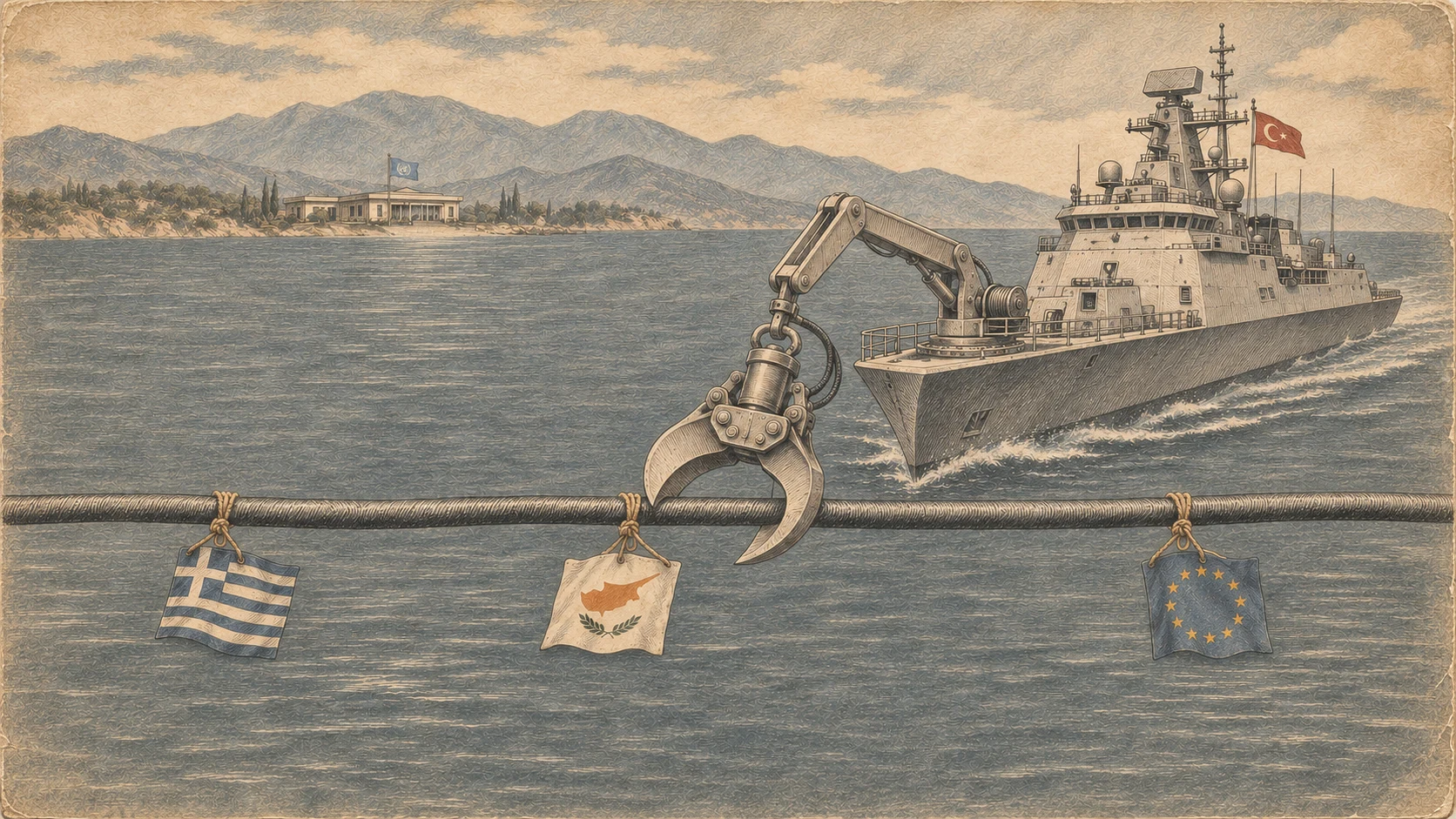
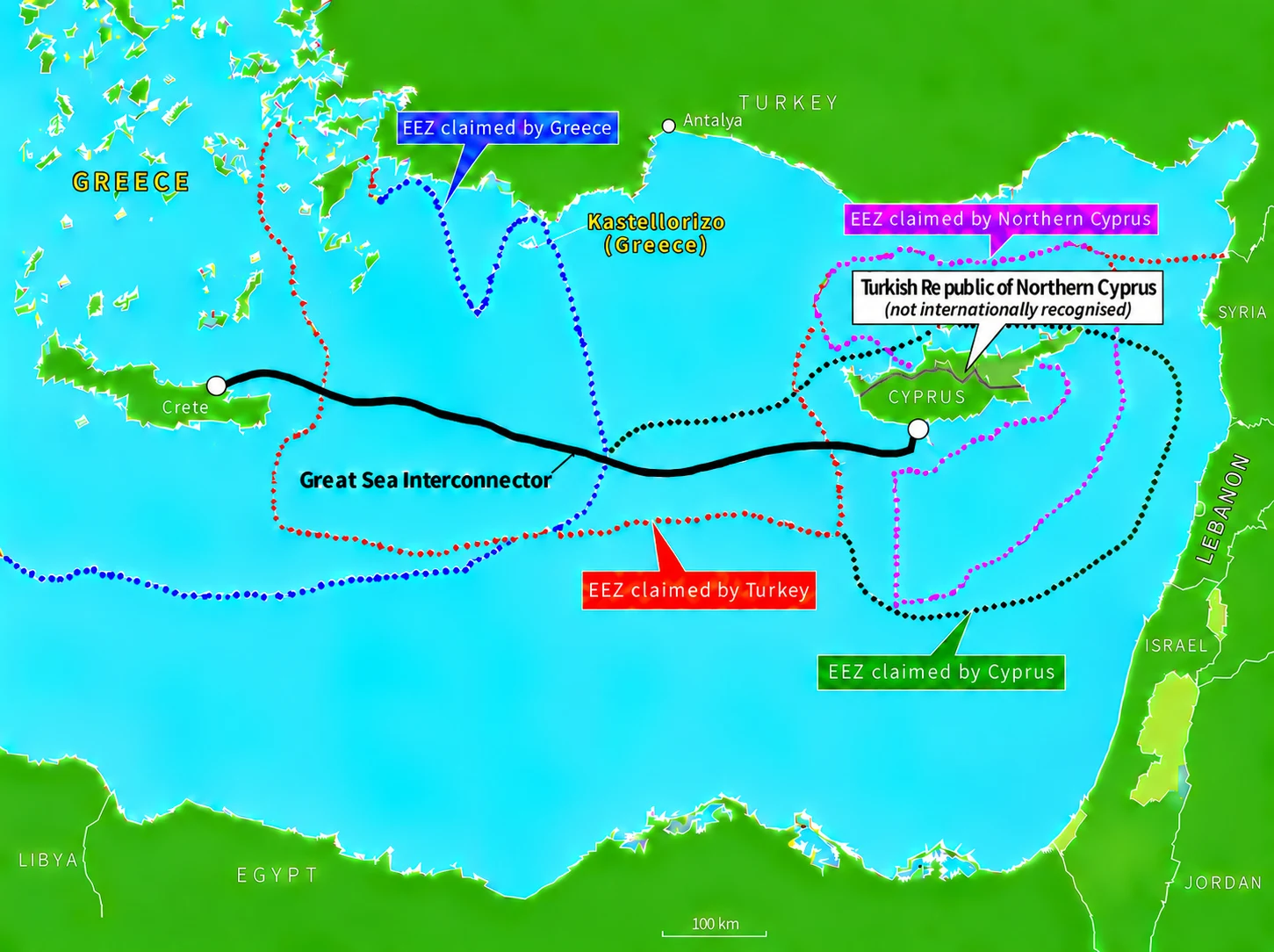
While Turkey practices what it preaches on electrification, two neighbours see hypocrisy in Ankara’s opposition to their comparable initiative. Roughly 250 kilometres south of Antalya, Greece and Cyprus are planning the Great Sea Interconnector (GSI), a 900-kilometre, €2 billion undersea electricity cable, the world’s longest and deepest of its kind, linking Cyprus to Crete, and from there to the mainland European grid. The EU is providing a third of the funding for this “project of common interest”, which wound end Cyprus’s distinction as the only member state without an electricity interconnection. Completion is tentatively scheduled for 2031. Ankara objects, not to the project per se, but to its route.
The GSI cable beneficiaries, signatories to the 1982 UN Convention on the Law of the Sea (UNCLOS), say it will run through their exclusive economic zones (EEZs). Turkey, which has not signed the convention, begs to differ. Ankara holds that the waters between Cyprus and Crete, beyond 12 nautical miles of territorial sea, are its jurisdiction. It has charted an EEZ mirroring the boundaries of its continental shelf, 200 nautical miles south of the mainland, including the bulk of the GSI’s route. Ankara insists that any infrastructure project traversing these waters must be coordinated in advance.
From Athens and Nicosia’s shared standpoint, the Greek and Cypriot zones meet slightly southeast of Kastellorizo, a small Greek island just two kilometres from Anatolia, whereas the Turkish EEZ is confined much closer to its shores. Athens and Nicosia argue that islands such as Rhodes and Crete are entitled to their own EEZs, per UNCLOS; Ankara retorts that this unfairly denies it the maritime territory standard for coastal states, citing international court rulings aligned with its stance. Turkey has shown it will uphold its claims with force: in 2018 it deployed warships to block an Italian vessel exploring for natural gas in waters claimed by Cyprus and again in 2024 to halt a GSI seabed survey. In 2020 it drilled in an area Greece considers part of its EEZ.
Ankara insists that its maritime disputes with Greece be settled through bilateral diplomacy rather than international law. Even here the sides differ: Athens prefers talks on delimitation alone, while Ankara wants a broader package covering airspace violations, migration and the divided island of Cyprus. That last issue complicates Nicosia’s efforts to delimit its waters. The self-declared Turkish Republic of Northern Cyprus, recognised only by Turkey, governs the island’s northern third and claims waters overlapping with Nicosia’s EEZ. Ankara refuses to recognise the Republic of Cyprus in its current form, as at COP31, when Erdoğan walked out before President Nikos Christodoulides spoke, and rebuffs its calls for delimitation, tying every outstanding issue to a political settlement on the island.
The GSI dispute shows how immediate national interests collide with abstract, long-term global priorities, and outside powers have joined the fray to advance their own. France, whose investment firm Meridiam is the majority shareholder in the cable company, planned seabed surveys while insisting it is not taking sides in the maritime boundary dispute. Athens, meanwhile, sought and received explicit American endorsement during a symbolic visit by US Secretary of State Marco Rubio last month, an endorsement reaffirmed more recently by Energy Secretary Chris Wright. Washington seeks energy security and regional connectivity in the Eastern Mediterranean, and some US lawmakers frame the electricity project as a core step towards actualising the India–Middle East–Europe Economic Corridor (IMEC), a G20-backed route linking India to Europe through the Middle East and countering China’s Belt and Road Initiative.
On 11 November, in the middle of COP31, Turkey issued a NAVTEX authorising the French vessel Abeille Marengo to survey two areas of GSI’s route until March 2027, in the same waters where it once blocked past activity. The wording matters. Ankara describes the work as taking place on its own continental shelf, so consent for this phase doubles as a reinforcement of its maritime claim. Greece declared the notice null and void, since the coordinates lie within its own zone. The host of a climate conference thus found it useful to look accommodating on a green-energy project without conceding its core stance.
The cable is part of a wider Eastern Mediterranean contest pitting Turkey against Greece. The stakes are amplified by the sizeable natural gas reserves in the EEZs of Egypt and the Levant states, estimated between at 3.5 and 10 trillion cubic metres, and Europe’s desire for energy security diversification due to disruptions from the Ukraine and Iran wars. Turkey’s strongest asset is Libya, divided in two since 2011 but possibly moving towards unity under Ankara’s sponsorship. Last month, the eastern Libyan government aligned with strongman Khalifa Haftar ratified the 2019 maritime boundary accord with Turkey, originally signed by the Tripoli-based western half. Ankara securing the support of both of Libya’s rival entities delineates a maritime boundary that Greece says ignores Crete, and overlaps with the western terminus of GSI.
Greece is not without allies. Egypt, long Haftar’s patron, rejected the accord as “null and void”, as did Cyprus, the EU, Bahrain and the UAE in a joint statement endorsing Athens. Israel, the potential destination of an expanded GSI, likewise condemned it. Washington called the ratification "unhelpful and provocative". Egypt and Greece have their own 2020 partial delimitation that contradicts the Turkish–Libyan accord, while Cyprus has signed a $1.8 billion gas-development deal to export to Europe via Egypt.
Ankara hopes to win over Cairo with a "better deal", reportedly 15,000 sq km of extra seabed, but Egypt has so far declined. Its absence from the pan-Sunni Mecca Defence Pact, linking Turkey, Saudi Arabia and Pakistan, heavy lobbying from Ankara, suggests it is wary of abandoning the regional alliances it has built. Lebanon, which signed an EEZ delimitation agreement with Cyprus last year, stays neutral on the Turkey–Libya accord. A Lebanese Christian diaspora group endorsed the Greece–Egypt axis, likely hoping to generate momentum in Beirut, while Erdoğan’s son Bilal reportedly urged Lebanon to join its side during a mid-November visit.
The Antalya summit’s coinciding with a stand-off over the GSI illustrates Turkey’s compartmentalisation of foreign policy and image-building. Ankara seeks recognition as a constructive global leader on climate and energy, yet insists that projects in its own backyard accommodate its position. To the world it broadcasts multilateral cooperation for a common good; towards its neighbours, it hints at zero-sum rivalry, if not hostility in the longer term.
Electrification depends on connection, and Ankara’s climate pitch sits awkwardly beside resistance to the very interconnection that would bring Cyprus into Europe’s grid. Ankara appears to have accepted GSI surveying, but on terms that uphold its maritime claims. It remains unclear whether this creates a precedent for wider engagement on the cable, or merely constitutes a one-time tactical avoidance of friction. In the interim, many Eastern Mediterranean states read Ankara’s COP31 pitch as “electrification for me, but not for thee”.

Comments
JOIN THE DISCUSSION.