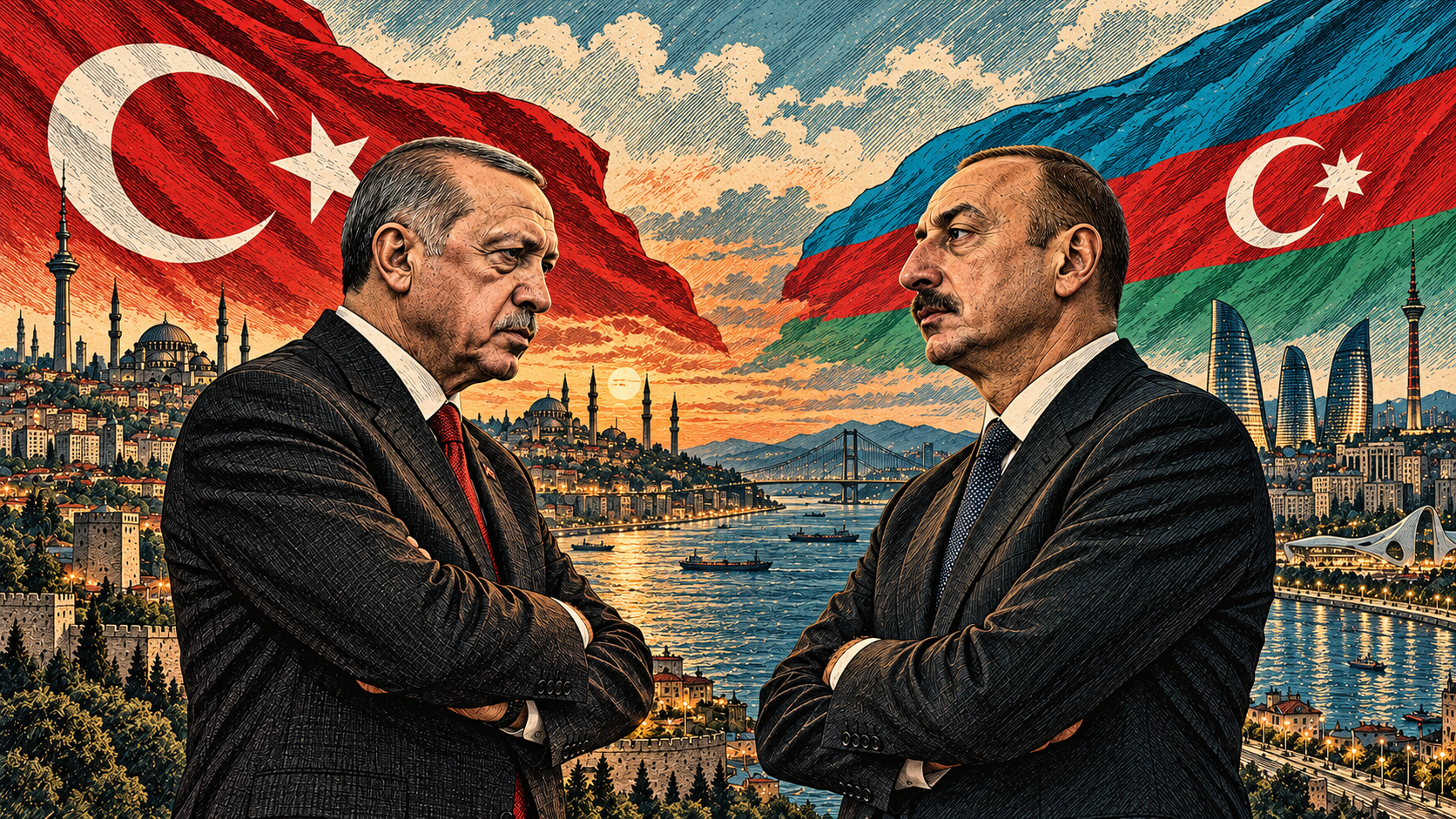
As two Turkic states, Turkey and Azerbaijan have long summarised their relationship with the slogan “two states, one nation”, each conducting a foreign policy that took the other’s interests into account. Since Azerbaijan’s independence in 1991, their alliance had been cemented through shared opposition to Armenia in the Nagorno-Karabakh conflict. Azerbaijan’s decisive victory over Armenia in 2020 was celebrated with a joint victory parade by the Azerbaijani and Turkish militaries in Baku.
Yet that victory removed a key anchor of the relationship and the remaining foundation of ethnic fraternity proved hollower than expected. Immediately after the war, President Recep Tayyip Erdoğan and other senior Turkish officials suggested that Baku’s defeat of Yerevan had been achieved largely thanks to Turkey’s military support. The remarks were ill-received in Baku and set the tone for its growing displeasure with Ankara.
This rhetorical clash intensified following the signing of the Shusha Declaration in June 2021, a bilateral military and defence cooperation agreement. The accord strengthened Baku’s security posture, particularly in relation to Tehran, but also had an unintended side effect. As discourse increasingly labelled Turkey as Azerbaijan’s “big brother”, perceptions of Azerbaijan as a sovereign state weakened. In Turkish societal discourse, Azerbaijan increasingly came to be viewed as a “satellite state”, a mere extension of Ankara’s sovereignty.
Turkish public opinion also expected Baku’s policies to align with Erdoğan’s Islamist-leaning, neo-Ottomanist outlook. Azerbaijan, however, diverges from Turkey in both domestic orientation and foreign priorities. Internally, it is a secular nationalist state whose national identity celebrates both its Islamic heritage and pre-Islamic roots, exemplified by its designation of Nowruz, the ancient Persian New Year, as a public holiday. Unlike predominantly Sunni Turkey, Azerbaijan’s population is majority Shia and not religiously observant. Baku regards its secularist framework as essential for internal stability and views Islamist movements on its borders as inherent threats.
To its southeast, the Shia Islamic Republic of Iran has long aspired to “export the revolution” and empower religious figures outside of state oversight. To its north, an on-and-off Islamist insurgency in Russia’s Dagestan region is flagged as an incubator of hardline Sunni Salafist teachings, whose spread has raised concerns about the potential to radicalise Azerbaijani youth. Some Azerbaijani elites have also raised concern over Islamist networks in “big brother” Turkey that spread dogmatic interpretations of Islam within Azerbaijan.
Externally, Baku seeks to broadcast a global image as a business and tourism-friendly destination and innovation centre, modelled on the UAE. It is cautious about foreign entanglements that could undermine its international standing or risk its growing role in the United States’ geopolitical orbit. It views Turkey’s interventionism in places like Libya, Somalia and Syria as adventurism that can backfire. These d provide a basis for understanding Baku’s “failure” to meet Ankara’s expectations since 2020.
One of the clearest examples is Azerbaijan’s increasingly strategic relations with Israel. During the 2020 war, Israel, much as Turkey did, provided uninterrupted arms shipments to Azerbaijan. These included advanced munitions, including game-changing loitering drones and long-range missiles that provided Azerbaijani forces with a decisive battlefield advantage. Israeli surface-to-air missile systems likewise provided robust air defence for Azerbaijan’s home front and troops against Armenian air attacks.
The outbreak of the Gaza war on 7 October 2023 did not disrupt Azerbaijani–Israeli ties. In contrast to the pro-Hamas stance and broader anti-Israel positioning the Erdoğan’s government (such as a May 2024 trade ban that remains in effect) Baku drew closer to Israel, seeing it through a realpolitik lens as an invaluable defence and energy partner. Ship-tracking data from Kpler indicated that Israeli imports of Azerbaijani crude oil via Turkey’s Ceyhan port rose 31% in 2025 from the previous year, averaging 94,000 barrels per day. Last year, Azerbaijani oil accounted for 46.4% of Israel’s petroleum imports. In early 2025, as the Gaza–Israel conflict persisted, Azerbaijan’s state-owned energy firm SOCAR purchased a 10% stake in Israel’s second-largest natural gas reservoir. Though a small-scale deal, it signalled Baku’s view of Israel as a strategically significant and long-term partner.
These developments were said to cause considerable discontent in Ankara, but stayed behind closed doors, as both sides continued to project an image of flourishing bilateral relations and intra-ethnic solidarity. Yet this mirage of harmony collapsed last month. During Israeli Prime Minister Benjamin Netanyahu’s UNGA address, the Turkish delegation joined nearly 70 other countries in exiting the chamber. Maksad Huseynov, Azerbaijan’s UN emissary, remained seated. The incident showcased Baku’s independent foreign policy, instead of mimicking Ankara, and provoked strong criticism in Turkey. Some Turkish commentators accused Azerbaijan of betraying the Muslim world and derided President Ilham Aliyev as a “friend of Israel”.
These developments were followed by an unprecedented moment in Azerbaijani politics. In a keynote address at the Eighth Congress of the ruling New Azerbaijan Party on 2 October, President Aliyev reaffirmed Azerbaijan’s commitment to an independent foreign policy and warned against outside interference in its internal affairs. Without naming any country, he warned that “everyone should know their place”, cautioning against foreign powers seeking to change Azerbaijan’s “way of life”.
On foreign policy, Aliyev proclaimed that Azerbaijan’s ideological calculus and strategy would be purged of ‘foreign elements and foreign influence’ and that Baku needed neither assistance nor protection from any other state. Aliyev argued, contrary to Turkish public discourse, that Azerbaijan had received insufficient international support during the Nagorno-Karabakh conflict and financed its own military buildup to achieve victory. Although Aliyev did not explicitly mention Turkey, it was widely understood to be the primary target of his criticism.
Some Turkish media outlets and commentators interpreted Aliyev’s remarks as veiled criticism of Turkey’s opposition to Baku’s burgeoning relations with Israel. Others highlighted Azerbaijan’s growing willingness to defy its “big brother” on other issues where its interests clashed with those of Turkey. Just one day before Aliyev’s speech, Azerbaijan and Greece held their first strategic dialogue in 13 years in Athens, despite escalating threats between Athens and Ankara over maritime jurisdiction in the Aegean Sea. Similarly, Baku has rebuffed Turkish pressure to recognise the Turkish Republic of Northern Cyprus, balancing relations between the self-declared entity — other than by Turkey itself — and the internationally recognised Republic of Cyprus.
The rift between Ankara and Baku has become more pronounced in the past week. Israeli President Isaac Herzog was invited to the seventh annual meeting of CICA, a 29-member forum of Asian countries, held in Baku. Turkish President Erdoğan decided to skip the conference, dispatching Foreign Minister Hakan Fidan in his place. Fidan orchestrated a walkout as the Israeli president began his address, returning to deliver a speech critical of Israel. A spat later emerged over Herzog flying on a regular passenger jet to and from Azerbaijan, circumventing a two-year-old Turkish ban on official Israeli aircraft from traversing its airspace.
Given Erdoğan’s absence at the CICA conference, attention has turned to whether Aliyev could reciprocate by skipping the Organisation of Turkic States summit in Ankara next week. Sending his foreign minister instead could cause a further deterioration in bilateral relations.
Meanwhile, Baku has promoted a narrative of a Turkish double standard on Israel relations. Its APA state news agency released an investigation revealing still-widespread Turkish–Israeli commercial ties despite the formal Turkish ban, based on Automatic Identification System (AIS) data. The report was removed from APA’s various foreign language platforms within hours of publication. State-aligned Azerbaijani media sources have since published content on Turkey’s wartime trade with Israel, interpreted as a public signal of Baku’s displeasure calibrated to avoid further escalation.
Aliyev’s focus on an Azerbaijani “way of life” in his 2 October speech addressed a widening rift over the two states’ differing approaches to religion and state. Turkey was established as a staunchly secular republic by Mustafa Kemal Ataturk, but has gradually witnessed an expanded role of Islam in the public space during Erdoğan’s 24-year rule. While Azerbaijan is respectful of its Islamic heritage, its constitution explicitly separates religion and state.
The Turkish–Azerbaijani disagreement over religion in the public sphere has most recently clashed on the issue of women’s headscarves. On 21 September, the Azerbaijani cabinet introduced a ban on the hijab in schools, emphasising its adherence to secularism. The timing added to the tension, as just a day later Erdogan would decry headscarf bans and wider Islamophobia in the West (likely referring to a recent prohibition in Austria) in his UNGA address.
The reported exclusion of headscarf-wearing students from schools in Azerbaijan prompted criticism in Turkey. Oktay Saral, a chief adviser to the Turkish president, condemned the policy on social media and called on Baku to reverse course. Azerbaijan responded through a segment on state channel, AZTV, alleging that Turkey’s ruling AKP party’s inserting itself into the headscarf debate constituted unacceptable interference in Azerbaijan’s domestic affairs. Some recalled that Turkey itself had a ban on headscarves at academic institutions until 2014, implying hypocrisy in Ankara’s criticism.
Ultimately, the current intra-Turkic rift is about far more than disagreements over foreign policy alignments or religious attire in the classroom; it is a contest over Azerbaijan’s autonomous decision-making and the limits of Turkey’s influence. For years, sections of the Turkish government and public opinion understood the “two states, one nation” principle to mean that Baku should subordinate its domestic and foreign policies to Ankara’s wishes. Aliyev’s recent statements and Baku’s responses suggest that this expectation has been firmly vetoed. Azerbaijan is signalling that its strategic partnerships, domestic policies and ideological direction are matters of sovereign decision-making, not subjects for approval in Ankara.

Comments
JOIN THE DISCUSSION.