
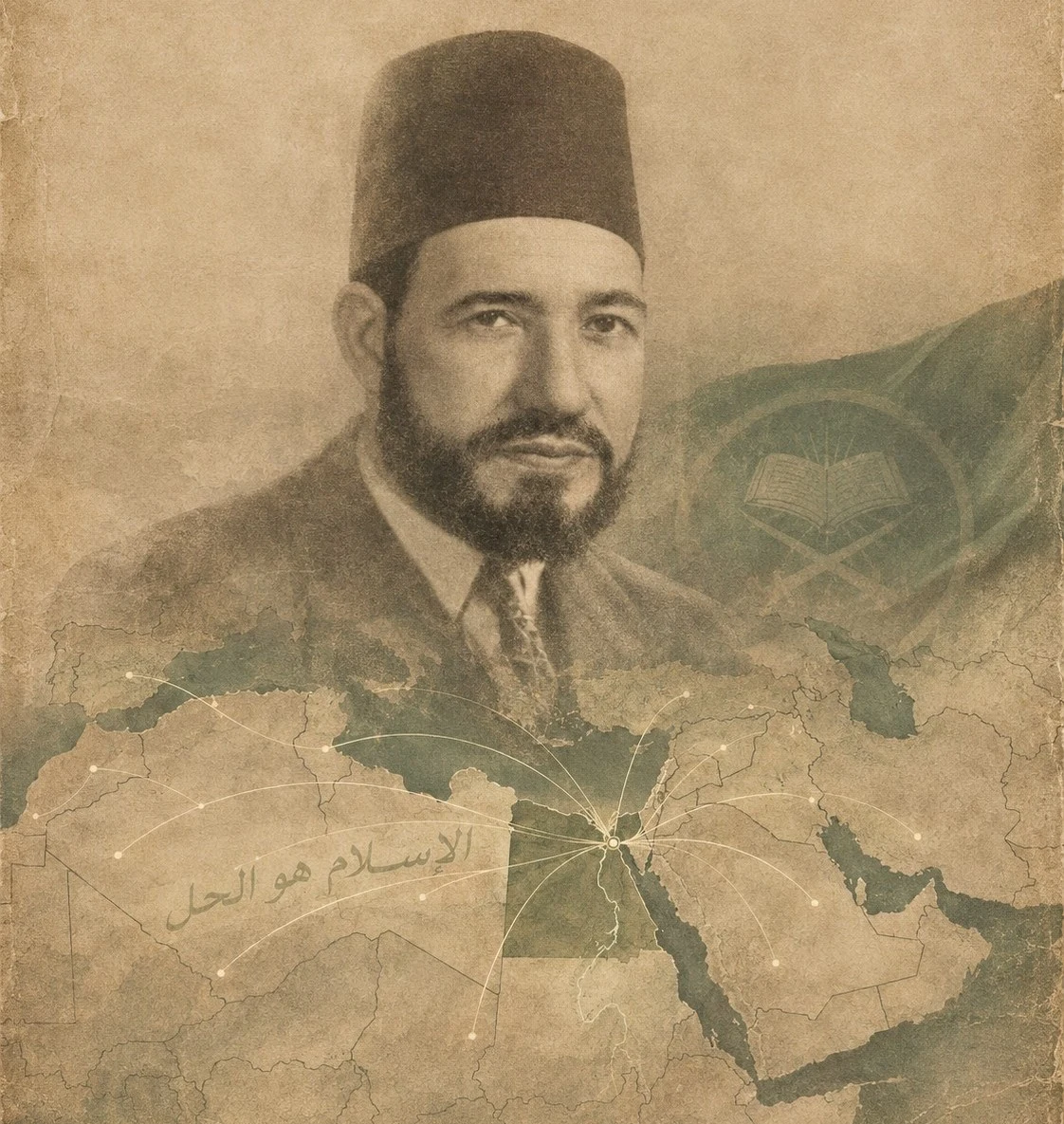
This week, Egypt permanently placed the Muslim Brotherhood on its list of terrorist entities, marking a new chapter in the country's decades-long confrontation with one of the Arab world’s most influential Islamist movements. The decision, announced by the Public Prosecution, parallels an expanding international campaign against the Brotherhood and several of its national branches.
Nearly a century after its establishment, the movement championing Islamic at the centre of political and social life finds itself in a dramatically different position from the one envisioned by its founder. Once a powerful grassroots force that sought to reshape Egyptian society and governance, it is now harshly suppressed at home and split among rival leaderships in exile in Turkey and the UK, and increasingly confronted by governments seeking to restrict its activities. Yet its ideological legacy continues to influence political and religious debates across the Middle East.
In 1928, in the Suez Canal town of Ismailia, a young schoolteacher named Hassan al-Banna set out to address what he saw as the Muslim world’s central predicament in an age of European dominance: political weakness, cultural dislocation and dependence on a materialistic West. Following the First World War, Egypt remained under British domination, while nationalism, liberalism and socialism promised competing visions of restoring Egypt’s greatness. The abolition of the Ottoman caliphate in 1924 signaled a symbolic defeat for proponents of the idea that Muslims worldwide constituted a single political civilisation. Al-Banna’s solution was the Muslim Brotherhood, a movement to reshape Islamic societies and governments alike, with Islamic guiding public and private life.
The Brotherhood began with preaching, education and charity. It established schools, clinics and social institutions, especially where the state served people poorly. After al-Banna moved to Cairo in 1932, it grew into a national movement. By the 1940s, it was a significant political force, opposing British influence while building a disciplined network of supporters.
Its doctrine was comprehensive but imprecise. Al-Banna regarded Islam as a totalistic system encompassing morality, economics, religion and government. The movement advocated a society guided by Islamic principles and ultimately by shariah, though its leaders differed over how this should shape legislation and institutions.
Its method was gradual: reform the individual, strengthen the family, improve society and eventually transform the state. This attracted traditional believers, educated professionals, students and Egyptians of many strips who were disillusioned with political elites. But gradualism did not resolve questions about minorities, women’s rights, personal freedoms or the relationship between popular sovereignty and religious authority. Its early history also included a secret paramilitary apparatus implicated in attacks and political assassinations.
A more confrontational current emerged with Sayyid Qutb, an Egyptian writer imprisoned under Gamal Abdel Nasser. He argued that societies that did not recognise divine sovereignty had fallen into jahiliyya, a term traditionally associated with the pre-Islamic age of ignorance in Arabia. His later writings, especially Milestones, influenced Egyptian jihadist groups such as Islamic Jihad and al-Gama'a al-Islamiyya, as well as Ayman al-Zawahiri, who served as Osama bin Laden’s deputy for years in succeeded him as al-Qaeda chief following his 2011 assassination by US special forces. These groups took Qutb’s ideas in more radical directions than the Brotherhood itself. Yet it would be dishonest to treat Qutb’s thought as the movement’s full doctrine: the Brotherhood generally pursued a more gradualist strategy and favoured operating within political and social system rather than seeking to overthrow it.
The Brotherhood initially supported the Free Officers who overthrew Egypt’s unpopular monarchy in 1952. The alliance rapidly collapsed, as Nasser built a secular, centralised nationalist state that clashed with the Brotherhood’s ambitions for an independent role for Islam in political life. After an attempted assassination of Nasser in 1954, his government outlawed the organisation and imprisoned thousands of its members. Al-Banna had been assassinated in 1949, and Qutb was executed in 1966. Repression dismantled much of the Brotherhood’s public infrastructure but did not extinguish its ideas. Prison, exile and clandestine networks became part of the rite of passage for its leaders.
Anwar Sadat, who succeeded Nasser in 1970, gave the Islamists greater room to operate, perceiving them a counterweight to Soviet-leaning leftists and pan-Arab Nasserists. The Brotherhood rebuilt its social networks and moved towards electoral participation, while breakaway militant groups pursued a path of armed struggle. In October 1981, Sadat was assassinated by the Egyptian Islamic Jihad, whose members did not officially represent the Brotherhood, even as some had previously been affiliated. Hosni Mubarak maintained the formal ban on the movement, but permitted its advocates to contest elections as independents and the movement as a whole to operate in social avenues.
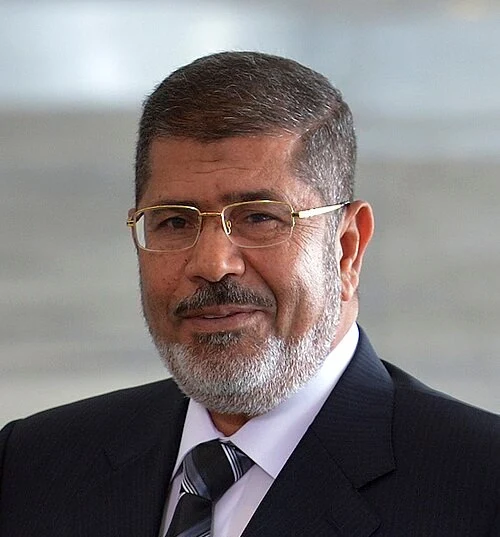
The 2011 Arab Spring appeared to vindicate the Brotherhood’s patient approach. Its political arm, the Freedom and Justice Party, secured 235 out of 498 seats in the parliamentary election after Mubarak’s fall. In June 2012, Mohamed Morsi became Egypt’s first elected civilian president, winning 51% of the vote in a runoff.
The movement proved less competent at governing than opposing authoritarian rule. Morsi faced a hostile bureaucracy, a powerful military apparatus, structural economic difficulties and a polarised public. Opponents accused him of strong-arming institutions and imposing his preferred social order with broad consensus. A November 2012 decree shielding his decisions from judicial review intensified those fears. Brotherhood supporters, however, saw a democratic mandate obstructed by actors tied to the Mubarak era.
Both dynamics mattered: Morsi’s decisions deepened opposition, while the military retained powers that electoral change could not easily dislodge. In July 2013, Abdel Fattah al-Sisi, then defence minister, removed Morsi from office. The ensuing crackdown killed large numbers of protesters, imprisoned Brotherhood leaders and drove others to exile. Morsi died in custody in 2019, without an established successor.
Removal from power exposed disagreements that state repression had long concealed. Older leaders favoured discipline and gradual adaptation; younger members questioned their timidity after mass arrest, and exiled figures competed with remnant networks inside Egypt, producing competing leadership groups by 2021.
The international Brotherhood was never as centralised as its reputation suggested. Branches in Kuwait, Syria and elsewhere developed distinct relationships with their national governments and societies. These chapters clashed with one another on pivotal regional developments, most characteristically Iraq’s 1990 invasion of Kuwait, reflecting how each internalised national interests over ideological consistency. Hamas emerged from the Palestinian Brotherhood’s ecosystem but developed a unique organisational structure, political strategy and armed wing. Islamist parties such as Tunisia’s Ennahda and Morocco’s Justice and Development Party share parts of the Brotherhood’s inheritance without being official branches.
Its present influence is uneven. In Egypt, its permanent designation as a terrorist entity formalises its existing marginalisation from public life; repression can be expected for any leaders who attempt to rebrand. In Jordan, it has been banned since April 2025 and announced its dissolution later that year; its political arm, the Islamic Action Front (IAF) has been pressured into rebranding itself and de-emphasising its Islamist orientation, despite winning 22% of parliamentary seats a year earlier.
Turkey and Qatar backed Brotherhood figures after the Arab Spring, while Egypt, Saudi Arabia and the UAE viewed the movement as a threat to established authority. These differences reflected national interests as well as ideological stances.
The Brotherhood’s decline as a unified movement should not be mistaken for the disappearance of political Islam. Its ideas, networks and methods continue to shape parties, charities and religious associations across the region. Almost a century after its founding, the Brotherhood is less a single political force than a contested inheritance. Its organisational power has diminished and Cairo may have officially terminated its existence, but its legacy lives on in contemporary debates over Islam, democracy and governance in the Middle East.

Comments
JOIN THE DISCUSSION.