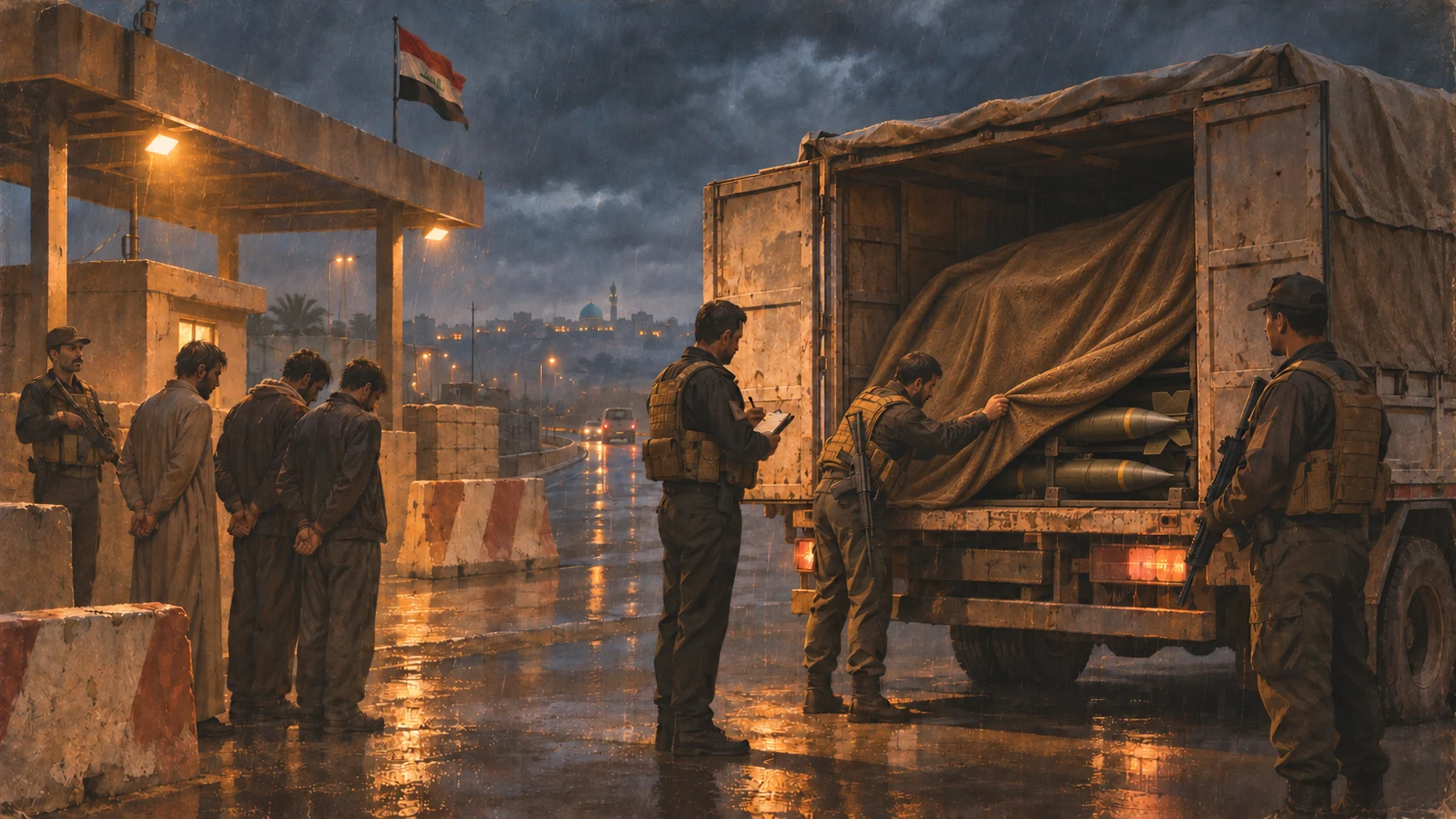
Nightfall in Baghdad, Friday, 6 November. A cool, cloudy evening with occasional rain. A truck traveling south of the capital approaches a checkpoint manned by Iraqi national security forces. Acting on intelligence, the troops scan the vehicle and uncover 35 missiles, and arrest three passengers. The checkpoint interdicted vehicles attempting to access off-the-grid roads in the Jurf al-Sakhar region, which are controlled by Iraq’s powerful, Iranian-backed Shia militias and off-limits to outsiders. Earlier that day, the office of Prime Minister Ali al-Zaidi announced the previous month’s figures for the campaign aimed at precisely this type of detainment: collecting weapons outside of state control. Baghdad recovered nearly 1,200 missiles and bombs, 15,000 rounds of ammunition and 4,400 light weapons, confiscated from over 38,000 citizens.
The three detained men were reportedly affiliated with a militia called the Ruhollah group, and operated in an area considered a stronghold of Kataib Hezbollah, arguably the best-armed of Tehran’s local proxies. The arrest is a microcosm of al-Zaidi’s overarching policy of reasserting state control: exercising authority over independent armed organisations, policing the borders, controlling the flow of energy and in positioning the country as an interlocker between Iran, the US and Arab neighbours.
Appointed in May as a consensus candidate between Washington, Tehran and Iraq’s main ethno-religious groups, the 41-year-old premier of Shia heritage lacked any political experience, a rarity for Iraqi leaders in the post-Saddam era that followed the US’s 2003 invasion. Rather, he is a multi-millionaire tycoon whose fortune comes from local retail and banking and who brings private-sector management experience to national challenges.
America called its war to overthrow Saddam Hussein “Operation Iraqi Freedom”, vowing to establish pluralistic democracy in its place. But toppling the dictator gave way to years of bloody sectarianism and instability, a prolonged US presence and rising Iranian influence. More than two decades later, al-Zaidi is pursuing a revised bid for independence: one that would give Baghdad greater control over its territory and its relationships with outside powers.
The premier presents his outsider status as proof that he is untainted by the corruption and sectarian patronage that have plagued Iraq’s political class since 2003 and ended the careers of many of his predecessors. Fighting corruption became his first priority. Less than two months into the job, he launched a nationwide campaign of arrests and cash seizures worth tens of millions of dollars, targeting politicians and officials across the sectarian divide.
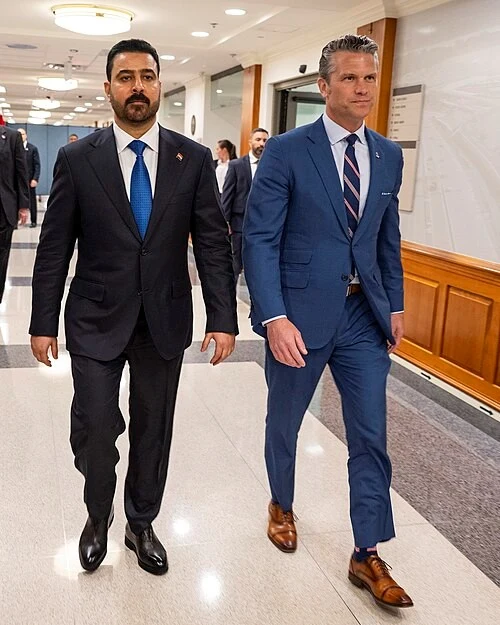
The Trump administration, under its Middle East envoy Tom Barrack, pressed al-Zaidi to disband Iran’s militias in Iraq. The Iraqi premier has tried to balance deference to a superpower ally with cordiality towards Iran, given the countries’ 1,600-kilometre-long border and extensive trade and political ties. Last week, al-Zaidi secretly visited Tehran, seeking to diffuse tensions and promote a US–Iran settlement. Days earlier, the premier spoke with US President Donald Trump —with whom he has tried cultivating personal bonds based around their shared business background — emphasising his rejection of Iraqi territory being used for aggression by Iranian-backed militias.
Baghdad similarly strives to navigate Washington’s demand to join its campaign to isolate the Islamic Republic alongside the realities of economic interdependence with its eastern neighbour. Bilateral trade is estimated at $10–$12 billion annually, most of it Iranian exports of consumer goods, food and other products; Iraq serves as Iran’s second-largest export market after China. Al-Zaidi hence has been reluctant to fully comply with “Iron Gate”, the US’s complimentary land blockade to its maritime one. Washington urged Baghdad to shut down seven of its nine land border crossings with Tehran; Baghdad has replied by only indefinitely closing one, the Mandali crossing, while re-opening another, al-Sheeb, that was temporarily suspended due to “incomplete technical readiness”.
That said, Iraq mostly adheres to an American ban on flights from Iran to Baghdad and other cities. Direct Iranian services largely limited to the holy Shia city of Najaf. Iraqi compliance went viral earlier this month when an aircraft transporting Iran’s national football team was denied landing rights in Basra for a regional tournament. The plane was forced to turn back mid-air, with the team reaching the Iraqi border by coach.
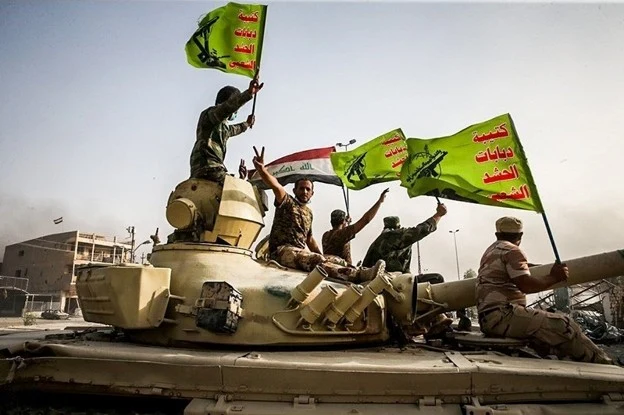
Al-Zaidi faces a much more daunting challenge in co-opting the country’s 60 or so militias, loosely organised under the umbrella group Popular Mobilization Front (PMF). Numbering as many as 240,000 fighters and benefiting from an annual $3.5 billion budget, the various Shia outfits were mostly formed in 2014 to fight the Islamic State’s expansionist Sunni caliphate, though some have operated since Saddam’s downfall.
The government is reportedly implementing a three-pronged strategy to defang the militias. The first group concerns militias with a corresponding political wing and considered less ideologically rigorous: Baghdad encourages their integration into national security forces, while offering their political counterparts’ positions within the state bureaucracy. A second group is composed of more hardline militias that lack well developed political affiliates (often due to their boycott of the political process) but still open to state co-option, such as Harakat Hezbollah al-Nujaba. They are being engaged through clandestine deals promising benefits for cooperation. The government touts enacting an amended law on PMF integration that ends their autonomous status but promises fighters state benefits and immunity for past actions.
The last group is the militias operating under Iran’s IRGC, especially Kataib Hezbollah, and uncompromisingly oppose relinquishing their weapons and subordinating themselves to national authority. The government aims to hamper their financial investments and commercial activities. Officials have spoken of progress in talks on integration, reportedly hoping to conclude them by June 2027 (Baghdad’s postponed disarmament deadline from September 2026, following the US withdrawal of its last troops from Iraq). Yet Nujaba and others have said they reject disarmament in any form; the recent checkpoint seizure serves as a reminder the persuasion may need to be accompanied by coercion.
Al-Zaidi’s confrontational approach towards the third group is playing out on the issue of illicit oil production. In recent days, al-Zaidi launched a probe into oil smuggling in Kataib Hezbollah’s stronghold of Jurf al-Sakhar, dismissing nine high-ranking officials from the provincial government. A leaked Interior Ministry report describes how for five years militias outside of state authority have been operating unauthorised refineries and smuggling oil in trucks that blends in with civilian traffic, netting them up to $30 million per month. A dedicated security agency has since been established to guard energy infrastructure and combat militias’ siphoning off oil from pipelines. On 15 November, al-Zaidi issued an ultimatum. Militias were given one week to cede extra-territorial control of Jurf al-Sakhar or face military action, possibly by the elite Counter Terrorism Service commandos, which executed the summer’s anti-corruption raids.
Baghdad has similarly sought to reduce vulnerability its energy exports amid the Iran war. Iranian attempts to disrupt the international waterway have cost Iraq $60 billion in lost oil revenue. Al-Zaidi has reached understandings with the Trump administration in shipping oil via small tankers through a southerly Hormuz route under US protection, transporting it to larger tankers once in the Gulf of Oman. In parallel, Iraq has managed to reroute overland 500,000 barrels per day (bpd) through Turkey’s Ceyhan port and 150,000 bdp through Syria’s Baniyas for export to Europe.
Iraq so far has managed to rebound from initial wartime shocks. International Energy Agency data shows oil production reached 4.6 million bpd in October, the highest rate since September 2019. More than 3.4 million bpd of that was exported, up from 3 million bpd in September 2026 and nearing the pre-war peak of 3.7 million bpd. Al-Zaidi set more ambitious benchmarks in the years to come: 7 million bpd by 2030, and 10 million bpd by 2032. His for an independent, globally integrated Iraq includes an open-door policy for foreign energy firms, especially western ones. To this end, he met with ExxonMobil’s regional representative in early November, and instructed Iraqi ministries “to give priority” to American companies in public tenders.
Similarly, al-Zaidi has deepened Iraq’s diplomatic role in the Middle East. He advocates for GCC dialogue with Iraq and Iran, a format known as 6+2, and has undertaken a series of regional visits since taking power. Last week, he became the first Iraqi leader to visit Bahrain in the post-Saddam era. Long fearful of Iranian intentions — marked by state-aligned figures calling for a takeover of the island — Bahrain was reassured by his emphasis on “common security” and opted to return its ambassador to Baghdad for the first time in two decades.
Other regional visits have highlighted Iraq’s geography and resources as a means for partnership. His July visit to Turkey centred on a similar pipeline, as well as progress in the Development Road transport corridor, meant to link the Gulf states to Europe via Mesopotamia. In late October, he visited Levant partners. First Amman, prioritising energy and alternative export routes, focused around the Red Sea port of Aqaba. Then Damascus, discussing joint fighting of ISIS’s remnant forces and and restoring the Kirkuk–Baniyas pipeline to align with Iraq’s long-term oil output targets. In all locations, Iraq’s diplomatic proposition is consistent: Baghdad wants to host the conversation rather than be its battlefield, and help forge a marked by interconnectivity and mutual trust.
The al-Zaidi strategy of being a friend to all shows promise, but depends on consistent action and retaining partners’ goodwill. Trump’s team must be persuaded that Baghdad is serious about confronting the militias, while Iran’s leadership must believe that Iraq seeks to mediate rather than enforce its economic strangulation. Arab states and Turkey need a strong Baghdad that controls its territory and build its side of the shared infrastructure. The prime minister’s ultimatum to Kataib Hezbollah will be a litmus test of whether his threats carry teeth. Iraqis, the neighbourhood and the world will be watching to see whether the confident businessman can become the effective statesman they have long been waiting for.
Comments
JOIN THE DISCUSSION.