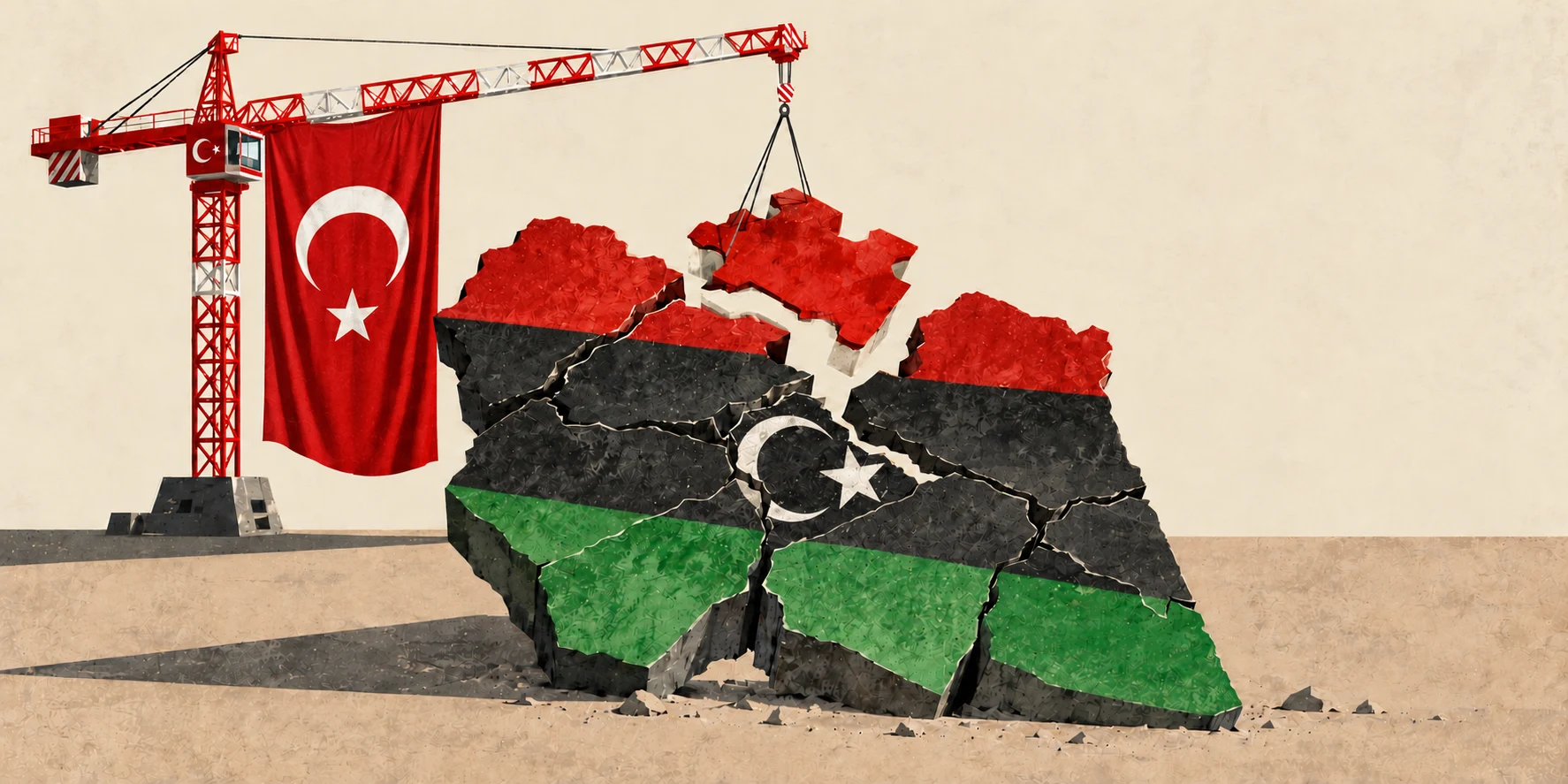
Fifteen years after Gaddafi’s fall, Libya is still a fractured state. The power vacuum created by the overthrow of the longtime strongman caused civil war, mass displacement and eventually consolidation into two parallel statelets. In the coastal west, based in the capital Tripoli, an internationally recognised government emerged, led by technocrat Abdul Hamid Dbeibah. On the eastern coast and in the southern desert regions, a government based mostly in Benghazi under the influence of ex-military commander Khalifa Haftar. Each side claims all of Libya as its own, but neither side has the power to defeat the other. The guns have largely fallen silent since 2020, with each side interacting in a manner that could be described as “trust but verify”. Turkey is leveraging its influence to unite both sides under a pro-Ankara alignment.
The western government was the easier prize. In 2019, Haftar’s Libyan National Army (LNA) tried to unite the nation by force, approaching Tripoli and threatening the globally-backed Government of National Accord (GNA). Ankara intervened militarily with the GNA’s blessing and fended off the LNA advance. Tripoli then signed a maritime memorandum with Ankara to delineate the boundaries of their Exclusive Economic Zones, which are disputed by Greece, Egypt and others in the region. Ankara deployed troops to Libya, cementing its influence with the GNA. Dbeibah was appointed as premier in a UN-backed process in 2021, though elections were postponed indefinitely, leaving him with an expired mandate at home and ever dependent on Ankara for security – including internally, where independent militias occasionally clash.
The eastern government was the harder sell. While nominally run by acting prime minister Osama Hammad, it is Field Marshal Haftar and his powerful army that truly call the shots. Haftar, 82, has run the eastern half for a decade, with his portrait displayed on billboards throughout the region. His branding as a stability-minded securocrat and fierce opponent of Islamism gained the backing of Egypt, the UAE and Russia. He has distributed power among his sons as he aged, and named his youngest, 35-year-old Saddam, as his successor. Meanwhile, he cultivated ties with this tripartite alliance and shunned Turkey as the patron of the rival government and an “occupier” of Libyan soil.
The relationship shifted from hostility to courtship in late 2023, as the eastern government’s parliament speaker visited Ankara. Recurring visits by Saddam Haftar to Turkey followed, while Ankara reopened its Benghazi consulate in 2024 after a ten-year closure. In 2025, Turkey’s head of intelligence, İbrahim Kalın, met with Khalifa and Saddam Haftar in eastern Libya, while the Turkish navy conducted exercises with both administrations’ fleets. Turkey began pressuring Benghazi to accept the 2019 maritime deal, as part of a package that would give the eastern government greater international legitimacy under Ankara’s guidance and access to Turkish military gear and business investment.
Eastern Libya’s decisive pivot towards Ankara came in early October. The legislature replaced its long-serving speaker, Aguila Saleh, an opponent of the deal and seen as representing Egypt’s interests. He was replaced by al-Salihin Abdel Nabi, formerly the head of a Libyan–Turkish friendship committee. On 20 October, the Haftar-aligned parliament voted unanimously in favour of the maritime deal, with Saddam publicly voicing his approval. The 110 lawmakers also repealed a parliamentary decision to sever political ties with Ankara. Tellingly, intelligence chief Kalın met with Dbeibah in Tripoli on the same day, symbolising Turkey’s leverage with both sides.
The eastern side’s vote does not bring the agreement into force, as Benghazi remains internationally isolated and the country still divided. Turkey is not the first outside player to push political reconciliation. Massad Boulos, US President Donald Trump's point person on Libya and a fluent Arabic speaker who was born in Lebanon, mediated Libya's first unified budget since 2013 in spring. He then arranged for both entities’ militaries to participate in the US-led annual Flintlock exercises in Libya. Leaks suggest the contours of Boulos’ grand bargain: a restored national government that would keep Dbeibah as prime minister while Saddam Haftar chairs the Presidential Council, alongside the gradual economic and military reintegration of the two entities. The UN, in a complementary process, urges elections by 2028.
Ankara seeks to finish what the US started, on its own terms. Three days after the eastern parliament’s vote, Saddam and Tripoli’s deputy defence minister met in Ankara to advance Turkey’s proposal to merge the two sides’ armed forces. Saddam is said to have agreed to abolish the General Commander position, created for his father in 2015, in exchange for heading the Presidential Council. Questions about ultimate control over the military and the location of its joint headquarters remain unresolved, but Turkey seems to have generated momentum towards a deal.
Egypt, the UAE, and Qatar — a Tripoli supporter — seem to back the Turkish initiative. Their representatives travelled to Ankara during the intra-Libyan talks to signal strong support. Meanwhile, reports surfaced of Boulos and Turkey’s influential Foreign Minister Hakan Fidan meeting in Cairo, an implicit nod to merging the two patrons’ proposals for reuniting Libya. Turkey’s president, Recep Tayyip Erdoğan, is expected to visit Tripoli in December, presiding over a summit to promote Turkish relations with Africa and highlight its special role in Libya.
Broader global interest in Libya centres on fossil fuel. Recent hostilities around the Strait of Hormuz sent oil prices skyrocketing, with Brent crude nearing $120 a barrel. Libya holds Africa’s largest proven oil reserves and offers a stable energy lifeline to its neighbours – whose energy security has been threatened by the nearly five-year-old war between Russia and Ukraine and the more recent one in Iran. Light Libyan crude reaches Italian refineries in 48 hours, without the need for naval escorts, while Egypt arranged to purchase 1 million barrels per month to offset supply disruptions caused by the war in Iran. Output in April reached a ten-year high of 1.43 million barrels a day thanks to improved security and coordination between the rival governments.
That said, Libya’s disunity prevents its energy production from reaching its full potential. In August drones attacked the refinery in western Libya’s Zawiya, the country’s largest, demolishing a fuel tank containing 4.5 million litres of petrol. The strike was attributed to a longer-running quarrel between Tripoli and a local warlord who controls parts of the town. A separate sabotage attempt by an “unnamed armed group” in September curbed production at the Sharara field, responsible for a third of Libya’s daily output. These incidents reinforce the sense of lawlessness in western Libya, where self-serving militias either operate or disrupt critical infrastructure as they see fit.
Eastern Libya’s energy dynamics operate somewhat differently but feature the same discord. Haftar’s territory includes a 400-kilometre-long coastal zone with the country’s four largest export terminals and two-thirds of its crude exports. The strongman granted the GNA’s National Oil Corporation (NOC) official control of the terminals to maintain international credibility; behind the scenes, however, Haftar alone decides how often and to where the oil will flow. Some of it goes to legal markets, while other volumes are reportedly smuggled to irregular forces in conflict zones, such as Sudan.
The hydrocarbons issue factors into attempts to bring the country back together. In 2022, Ibrahim Dbeibah, the prime minister's nephew and security adviser, and Saddam Haftar agreed to keep oil flowing through Arkenu, a Haftar-linked company. The two Libyas run parallel financial mechanisms, which the unified budget only partly reconciles, and the Central Bank of Libya in Tripoli is itself a battleground: the eastern parliament accepted its governor's resignation in principle two days after the Turkey vote. The Ras Lanuf refinery currently sits idle, its feuding factions neither able to agree nor secure the investment needed to modernise the ageing plant.
For Saddam Haftar, ratifying the Turkish maritime deal and Ankara’s patronage boost his global credentials as a legitimate Libyan actor, part of his bid to govern a re-integrated Libya. Like heirs in family dynasties elsewhere in the Arab world, such as Jordan’s Hashemite monarchy, Saddam is gradually being given greater responsibilities. He is engaging foreign leaders independently of his father with increasing frequency, accumulating governing experience and diplomatic acumen.
Saddam is no different. He has received red-carpet treatment in Washington in June and Abu Dhabi in September, and has been invited to visit Doha. On the ground, Saddam will need to find an arrangement with western armed groups and faces political rivals; some in Tripoli, including Mohamed al-Menfi, head of the Presidential Council, fear for their own positions, and are resisting any settlement that elevates the Haftars above themselves.
Turkey’s courtship of Saddam is also seen as its hedge against a potential collapse of Dbeibah's government, in which the latter’s security-centred profile could bolster his candidacy as a suitable replacement. But Saddam could also find a challenge from Ibrahim Dbeibah, the aforementioned nephew of the prime minister who advises him on security and is said to exert undue influence. Ibrahim also aspires to lead a consolidated Libya. For now, he and Saddam meet occasionally to discuss their respective sides’ positions, cooperating but likely eyeing each other as rivals for the crown. But the “sides” may reflect more family interests in power and succession than territory.
If Libya is to be united, it seems to be headed in the direction of family dynasties resembling Arab monarchies more than a pluralistic democracy. In any potential power-sharing arrangement, Ankara is likely to hold veto power or ultimately be the deciding factor in which individual wields what authority.
Comments
JOIN THE DISCUSSION.