On Saturday 17 October, more than half a million people marched across France, according to its Interior Ministry. Many invoked a skyrocketing cost of living and disillusionment about their future as the motives for bringing them out in the streets. The demonstrations fed off the momentum of earlier protests over dire conditions in French public schools. Some protests turned violent, with national symbols among its victims: a 143-year town hall was torched, Marseille’s municipal buildings were damaged and Paris’s Place de la Republique vandalised.
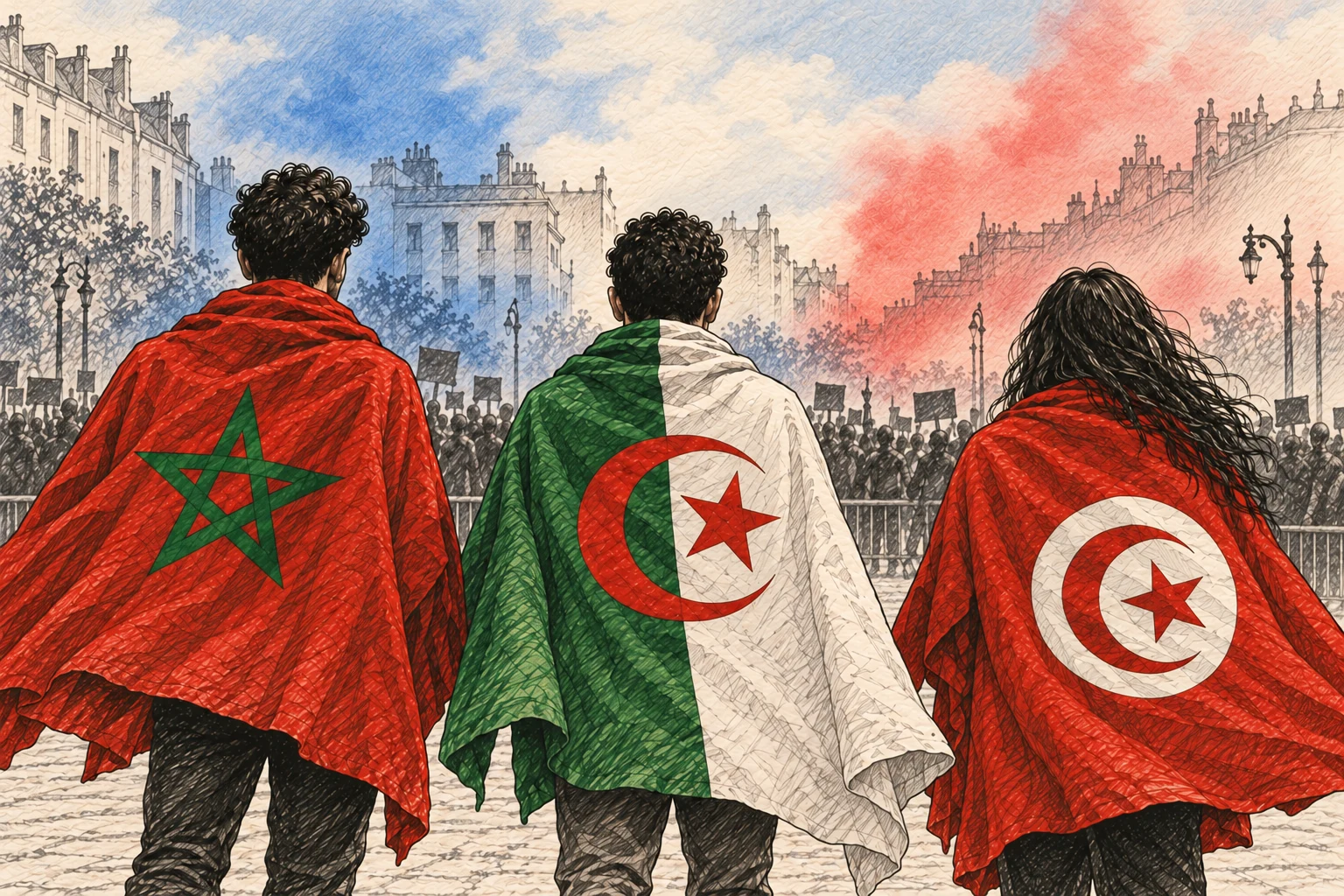
Social alienation from France, alongside identification with global social justice causes and solidarity with homelands of migrant communities, also provided inspiration. Palestinian flags appeared occasionally, while press coverage showed a scattered waving of the Algerian flag. Last weekend’s peak coincided with the 65th anniversary of French authorities’ brutal suppression of an Algerian pro-independence march in Paris. These signs hinted at the conflicted identities of French of North African descent: citizens of the republic on paper, yet still searching for past association and symbols of belonging. This past weekend brought a similar mobilisation of hundreds of thousands of protestors and clashes on the streets, suggesting that the underlying frustrations may not disappear anytime soon.
While the cameras stay on France and its youth, their peers in North Africa are voicing similar grievances for nearly identical socio-economic reasons: disillusioned prospects for upward mobility and fears that their leadership ignores their plight. In Tunisia, protests have been the preferred method; in Algeria, where a strongman leader restricts political expression, youth have either voiced their concerns online or through abstaining from the political process; in Morocco, the aftermath of a year-old youth protest wave is still fresh as the newly-installed government drafts next year’s budget.
In central Tunis, thousands marched on that same pivotal day, 17 October, over claims of economic desperation and an apathetic government. It was reported as the largest against President Kais Saied since he consolidated power at the expense of the parliament between 2021 and 2022. Leading the march was the UGTT labour union and other civil society groups, with several sources estimating 3,000 participants.
The setting was intended to evoke a theme of historical continuity in Tunisians’ struggle for accountability. Protestors descended on Habib Bourguiba Avenue, the nexus of the 2011 Arab Spring uprising that toppled autocrat Zine El Abidine Ben Ali and later the site of post-revolution protests demanding safeguarding of the democratic process. On 17 October, opposition parties joined lawyers, doctors, journalists and jobless Tunisians, in a rare display of solidarity across social and class lines. The trade union warned of worsening living conditions, denouncing what it characterised as Saied’s increasingly centralised governance and calling on him to release jailed critics.
Spontaneous protests have since sprung up across the country, ranging from Tunis’ suburbs to the second-largest city Sfax over claims of inadequate governance. Recent discord has been fueled by volatile incidents in which security forces killed suspects under disputed circumstances or detainees died after receiving subpar medical treatment.
A string of public sector failures during a record summer heatwave (with temperatures nearing 50-degrees Celsius) has fuelled popular anger against Saied. On 25 July, both the fifth anniversary of Saied’s suspension of parliament and a symbolic national holiday marking the 1957 abolition of a short-lived monarchy, Tunisians demonstrated against rolling blackouts caused by the grid’s inability to cope with demand for air-conditioning. The Organisation of Young Doctors in Tunisia estimated up to 200 deaths related to heatwave-induced blackouts, a toll that authorities have not confirmed nor denied.
The state utility blamed record demand and called the outages a one-off preventive measure, while Saied characterised their pace as “not normal” while demanding accountability to those responsible, but effectively evaded responsibility and offered no remedies. Water shortages caused by electric pumping stations idling during the blackouts compounded frustrations. In late August, hundreds of students demanded Saied’s resignation over the state’s failure to prepare for the heatwave. In parallel, Tunis saw demonstrations over price hikes and shortages of basic goods.
Beneath these crises lie a structural malaise. Unemployment stood at 14.9% in the second quarter of 2026, but surpassed 26% among university graduates and 35% among 15- to 24-year-olds. GDP growth was 2.1% in the first half of 2026, and the World Bank projects just 2.3% for the full year, figures too modest to deliver meaningful economic improvements for Tunisian youth. Inflation hovers at 5% while wages lag. Negotiations on a conditional IMF ballot were suspended in early 2025, while European and US aid is increasingly restricted over Saied’s perceived authoritarianism.
More than 100 unemployed graduates and their parents joined a 300-kilometre “Dignity March” towards the capital in late September, demanding a public-sector employment law. Police halted the procession outside of Tunis on 6 October. Whereas Saied had acknowledged past government shortcomings in response to the summer protests, however insufficiently according to the demonstrators, he has remained conspicuously silent on the Dignity March and recent demonstrations.
Tunisians’ street mobilisation suggests a generation declaring that its future lies either in far-reaching change within, or in emigration. Last Friday, 23 October, was the seventh anniversary of Saied’s rise to power, which many Tunisians view as the starting point of the gradual dismantlement of their nascent democratic experiment. In commemorating this date, many also express bitterness that Saied's demand for emergency powers in order to stabilise the country did not bring promised prosperity. The timing may serve as a new lightning rod for youth mobilisation.
Algeria’s younger generation faces similar pressures, but protest there carries a heavier price. The Hirak movement ended Abdelaziz Bouteflika’s 20-year rule in 2019, yet his successors have similarly curbed peaceful dissent. When the internet-based Manich Radi (‘I am not satisfied’) campaign surfaced in December 2024, Amnesty International documented the conviction of at least 23 activists and journalists within five months. Appeals for a “Gen Z” protest wave on social media followed in October 2025, inspired by a parallel youth movement in Morocco, citing 30% youth unemployment and declining hydrocarbon revenues that fund social services. Security forces were deployed en masse, stymying the protests, while Algiers blamed unspecified “foreign interference” rather than examine cost-of-living grievances raised by the digital activists.
With street protests risking arrest, Algerians have turned to boycotts. In July’s parliamentary elections, domestic turnout barely surpassed 20%, and stood at 11% among expatriates, both record lows. That diaspora is centred largely in France, which further complicates the identity questions above: sentimental attachment to the Algerian homeland, but rejection of its closed political system — and by implication of returning there. Algerian establishment parties retained their parliamentary majority, giving Bouteflika’s successor, President Abdelmajid Tebboune, a rubber stamp for his agenda. Observers caution, nonetheless, that while Algiers’ internal stability may be manageable for the time being, it could be undercut in the long-term by eroded public trust and unaddressed socio-economic stagnation.
Conscious of these trends and their viral digital footprint, Rabat appears determined to avoid the scenes in Paris and Tunis. On 17 October, King Mohammed VI chaired the new government’s first discussion on the draft 2027 Finance Bill. The government, led by Fatima Ezzahra El-Mansouri, has prioritised strengthening Moroccans’ purchasing power as the bill’s main priority. The draft law calls for structural reforms to markets and pricing, alongside increased direct social assistance. Its secondary priority is deepening youth participation in higher education, training and employment through a five-year national programme and allocating roughly $25 billion for regional development programmes to narrow existing social inequalities.
The government is right to be concerned. Last autumn Morocco witnessed a month-long “Gen Z” protest movement over health and education disparities. That the new government (which received a slightly higher turnout than Algeria’s, though still a very low 38%) is putting young people at the top of its agenda, amid youth unrest in France, is clearly a sign of mitigating risks. Moroccan authorities forecast economic growth of 5% next year and hope to limit inflation at 2% and a budget deficit of 3% of GDP. El-Mansouri’s task will be ensuring that these promises translate into employment opportunities and more affordable living, especially as the country spends heavily on infrastructure investments to prepare for its role as a co-host of the 2030 World Cup.
From Tunis to Casablanca, youth across the Maghreb are experiencing a shared frustration: the cost-of-living outpacing opportunities, public services lagging and little say in either. Tunisia’s protests have been far smaller in scale than France’s and less visible in global media, while Algeria and Morocco share common economic and social challenges that, if unresolved, could catalyse youth into mass protest.
Policymakers should not neglect the southwestern shore of the Mediterranean while France continues dominates the agenda. State repression that ignores the demands of its youth could generate increased flight across the sea as the optimal solution for hundreds of thousands, if not millions, of North African youth. Given growing anxieties over immigration and its potential to harm social cohesion, the economic stability and political accountability of North African states are inherently national security interests for Europe.
Comments
JOIN THE DISCUSSION.