
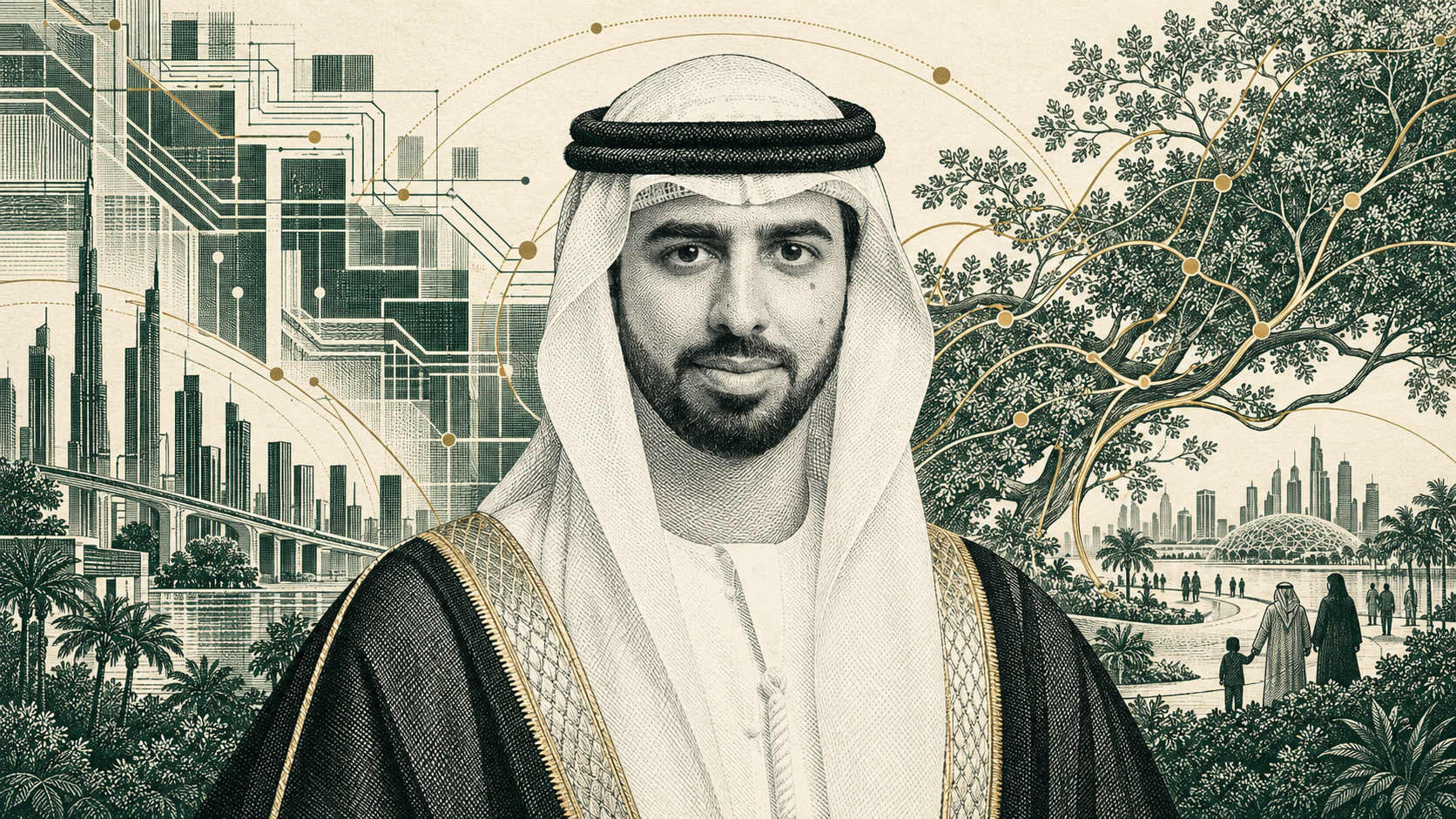
When Sheikh Zayed bin Sultan Al Nahyan unified seven Gulf emirates in the 1970s, they were sitting on millions-year-old black gold. In the present, with oil resources diminishing, his heirs are pouring their vast wealth towards forward-looking economic growth engines around the AI ecosystem.
Today, many governments in the West grapple with cautious AI regulation and the risks of digital monopolies. Meanwhile, the UAE is carrying out a Fourth Industrial Revolution. Abu Dhabi’s programme blends state-guided investment, technological ambition and geopolitical pragmatism. It wagers that today’s petrodollars can purchase tomorrow’s digital sovereignty, beyond merely purchasing computing power. This ambitious experiment poses a fundamental question for the Emirati leadership: can its closed political system coexist with the patenting of original technologies?
The UAE was among the first countries to tailor a coherent AI policy. In 2017, long before ChatGPT spawned a data and information revolution, the UAE appointed Omar bin Sultan Al Olama as the world’s first minister for artificial intelligence. Al Olama’s role was not merely a public relations stunt. It was the opening act of a comprehensive plan, the National Strategy for Artificial Intelligence 2031.
The Emirati vision rests on sober calculations of global trends. Sooner or later oil and gas reserves will lose their decisive clout. A new economy built on glitzy property, luxury tourism and international trade still remains exposed to unpredictable global shocks. For 21st century economic security, Abu Dhabi must convert its surplus capital into an ever-important asset: computing power. The country’s concerted focus on weaning off oil dependency has seen parallel measures to AI infrastructure development. According to the UAE’s ambassador to the US, Yousef Al Otaiba, the Emirates’ new focus partially informed its decision to quit OPEC unilaterally this year.
The UAE sees this emerging technology not as a risk to be managed but an element of the state’s operating system. Indices of technological readiness put the Emirates at the top of global adoption rankings. According to Microsoft, more than 70% of the UAE’s workforce uses generative-AI (GenAI) tools every week, twice the rate in Britain or Germany.
The Emirati edge stems less from superior algorithms than from minimal bureaucratic interference. With a mostly urban, digitally connected expatriate population, the UAE is an ideal AI “sandbox”. Health systems such as Malaffi pool medical records into a central database for predictive analysis, unbounded by the strict privacy laws of many Western countries. A presidential order mandates that every ministry have a chief AI officer; the “Zero Government Bureaucracy” programme automates visas and licenses; and Dubai’s airports have converted to biometric border controls based on computer vision.
FROM CRUDE TO COMPUTE Four pillars of the UAE’s AI strategy | |
|---|---|
01. TALENT & RESEARCH ACADEMIA (MBZUAI) Global faculty, generous research budgets and ten-year Golden Visas. | 03. COMPUTE & ENERGY DATA CENTRES G42, advanced chips, Barakah nuclear power and low-cost solar support energy-hungry computing. |
02. HOME-GROWN MODELS FALCON AND JAIS TII’s open Falcon models; Jais brings Arabic-English AI to regional markets. | 04. STATE & STRATEGIC CAPITAL GOVERNMENT AND PARTNERSHIPS Government-wide AI adoption, sovereign investment and US partnerships, including Microsoft and Pax Silica. |
Yet rapid adoption reveals a paradox. A country can become an enthusiastic user of Silicon Valley's products while remaining dependent on foreign services, products and cloud infrastructure. Abu Dhabi concluded that becoming a technological power required moving from importation to domestic production.
In May 2023, Abu Dhabi’s government-supported Technology Innovation Institute (TII) released the Falcon 40B language model, followed by Falcon 180B and Falcon 2. Unlike the closed models of OpenAI or Google, the Emirati models had their weights released under an open-source licence with almost no restrictions. Falcon products quickly climbed to the top of Hugging Face’s LLM leaderboard. An academic paper by TII’s researchers, “The Falcon Series of Open Language Models”, revealed a meticulous method for filtering data (the RefinedWeb dataset).
The first aim is to commoditise the elementary layer. If foundation models become free and accessible products, economic value migrates to cloud infrastructure, hardware and specific applications — areas in which the UAE already heavily invests. The second is digital independence for emerging markets. Abu Dhabi tailors bilingual Arabic–English models, such as Jais, jointly developed by Inception (a subsidiary of local AI and cloud computing conglomerate G42) with American AI chip manufacturer Cerebras Systems. Through this product prioritisation, the UAE can brand itself as a pre-eminent technological leader in the Arab world and the “global south”. It can claim the authority to speak for countries that wish to avoid reliance on Silicon Valley monopolies and subordination to Western moral diktats.
The Emirati strategy has been compelled to navigate contemporary geopolitics, namely the Washington–Beijing rivalry. G42, headed by national security adviser Sheikh Tahnoun bin Zayed Al Nahyan, became a focal point in this battle. For years, the Emirati technology conglomerate courted Chinese firms, from Huawei servers to genomic collaborations with BGI. But when the Biden administration began imposing tough export controls on advanced AI chips, Abu Dhabi understood that neutrality was no longer an option.
Peng Xiao, G42’s chief executive, led a swift and highly publicised “decoupling”. He removed Chinese equipment from its server farms and cut ties with Beijing’s telecoms giants. An American reward soon followed. In April 2024 Microsoft announced a $1.5 billion investment in G42, part of a White House-backed agreement that also included a board seat for Microsoft’s president, Brad Smith. The UAE received regulated access to the world’s most advanced chips. In return, the Emiratis agreed to monitor data flows and align with the US on critical technologies.
This pro-Washington tilt has deepened during Donald Trump’s second presidency. In January 2026, the UAE joined Pax Silica, an American initiative to strengthen AI and semiconductor supply chains among trusted allies and reduce dependence on China for rare earth minerals. US Under Secretary for Economic Affairs Jacob Hellberg praised the UAE for its visionary leadership, economic diversification, technological ambition and ability to become a major partner in the global AI and semiconductor industries. For foreign audiences, Abu Dhabi could present its Pax Silica membership as an acknowledgement of peer status with more well-known technology powers allied to Washington, including the UK, Germany, Australia, India and Japan. Domestically, the pact advanced its long-term goal of economic diversification away from petroleum and towards modern technologies.
The UAE has leveraged its advanced infrastructure to supply the massive amount of energy needed to power AI systems uninterruptedly. The four reactors at the Barakah nuclear power plant produce up to 5.6 gigawatts of carbon-free electricity — crucial for energy-intensive data centres that cannot rely solely on intermittent renewables. In parallel, the country’s extremely dry and sunny climate has been harnessed. Solar-powered installations such as the Al Dhafra project generate electricity at some of the lowest costs per kilowatt-hour in the world.
Abu Dhabi has deployed an extensive network of cooling servers to preserve its AI data centres’ operations during scorching summers, where temperatures routinely top 45°C. Large-scale investments in liquid-immersion advanced cooling technologies and desalinated water safeguard the country’s ability to produce sizeable computing power.
Alongside the cultivation of home-grown scientific talent, the UAE’s AI strategy has leaned heavily on recruiting foreign researchers. Institutions such as the Mohamed bin Zayed University of Artificial Intelligence (MBZUAI), led by renowned American computer scientist Eric Xing, court leading academics with tax-free salaries, generous research budgets and ten-year “Golden Visas”.
Yet critics question the long-term viability of the UAE’s AI-centric development model. The UAE remains an absolute monarchy that runs tight digital surveillance and shows zero tolerance for political criticism. Technological breakthroughs do not rest on expensive hardware alone. They require a culture of complete openness, scientific scepticism, freedom of expression and a willingness to embrace creative chaos. Can an R&D ecosystem working under these system constraints truly challenge the leading research paradigms? Or will it stall amid attempts to integrate technology conceived elsewhere?

Comments
JOIN THE DISCUSSION.