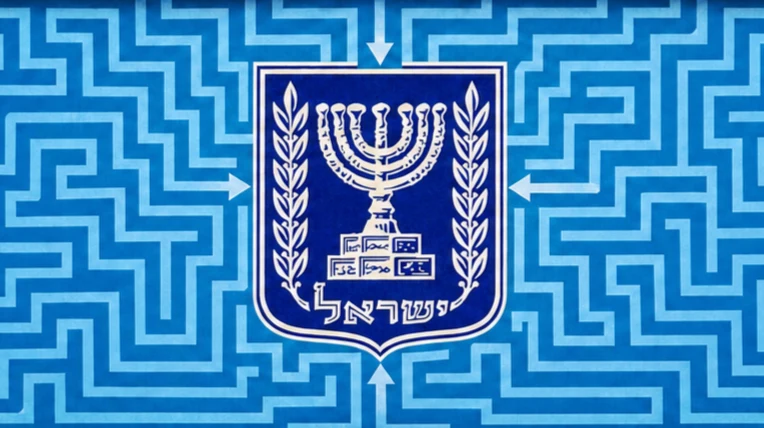
Yesterday, Israelis voted in their first election since Hamas's attack of 7 October 2023. Security dominated the campaign; economic and social issues, though important, did not drive it on their own merits. The central question was the one that has defined Israeli politics since 2019, when a stalemate began that produced five elections in less than four years: should Benjamin Netanyahu, the long-serving prime minister, stay in office or go?
Much like the majority of those earlier elections, this one appears to have eluded a decisive winner. With about 85% of the ballots counted, Netanyahu’s Likud remains the largest party, with a projected 26 seats in the 120-seat Knesset, Israel’s unicameral parliament. Donald Trump, who endorsed Netanyahu ahead of the election, has claimed that his backing turned a predicted defeat into a possible victory, or, at the very least, a stalemate. When adding the ultra-Orthodox and far-right parties of his outgoing coalition, Netanyahu’s bloc stands at 53: eight short of a majority, and well below the 64 it won in 2022. His chances at securing several more seats were impeded by the lacklustre showing of several small right-wing parties that failed to cross the minimum 3.25% threshold to enter the parliament.
Netanyahu’s primary challenger is Gadi Eisenkot, a former Israeli chief of staff of the army who sat alongside him in the wartime cabinet formed after 7 October. His bloc, composed of the centre-right and the left, appears to have secured 49 seats. Within it sits Yair Lapid, the current leader of the opposition and a former prime minister, who teamed up with another former premier, Naftali Bennett, under the latter’s leadership. Their joint list, which they called B'Yachad, is projected to win only around half as many seats as Eisenkot's Yashar!, below expectations.
Straddling the two camps are two Arab lists, which together are on course for as much as 19 seats, up from ten in the last Knesset and a record. They represent distinct approaches to the political system for the country’s 20% Arab minority. Ra'am, an Islamic-oriented party headed by Mansour Abbas, became in 2021 the first Arab list to sit in an Israeli government, and has again signalled interest in joining a coalition; it has fielded Yoav Segalovich, a Jewish former senior police officer, in a bit to strengthen its crime-fighting credentials, amid a rising wave in Arab towns. The Arab-nationalist Joint List, led by Yousef Jabareen, is historically wary of joining Israeli governments; it rejects the country’s Jewish character and opposes many of its military operations. Nonetheless, Jabareen’s party say it stands ready to help oust Netanyahu.
The two could prove kingmakers. Eisenkot's bloc and the Arab parties together command 67 seats, a majority on paper. But Netanyahu has ruled out partnering with them, and Eisenkot has set conditions that many Arab lawmakers are unlikely to accept. Parties within both blocs may add pressure on their respective leaders to maintain these stances. Final figures will shift as counting continues, with pivotal votes of soldiers and other constituencies yet to be tallied.
On paper, many parties in the Netanyahu and Eisenkot blocs broadly align on security and foreign policy, but bringing them together is much easier said than done. Israel's most recent experience of cross-aisle government is not encouraging. The unity government of 2020, in which Netanyahu was to hand the premiership to Benny Gantz after a year and a half, collapsed within about seven months and the rotation never happened, leaving many parties wary of cooperating with him. Many Israelis, meanwhile, regard Netanyahu as unfit to continue, citing his corruption trial and his responsibility for the failures of 7 October.
The vote also came months after Israel and America went to war with Iran, a weeks-long conflict whose underlying conditions have not been resolved. Fighting in Gaza and Lebanon has stayed open-ended; critics of Netanyahu bemoan the lack of a "day-after" diplomatic strategy for turning military gains into political arrangements. At home, the ultra-Orthodox parties' demand for blanket exemptions from military service raised the stakes. Many reservists on lengthy deployments, and families mourning fallen soldiers, resent what they see as an unfair sharing of the burden of national defence.
What happens next? The final tally is expected by 30 October and official results on 4 November. President Isaac Herzog will then consult the parties and charge one candidate, not necessarily the leader of the largest party, with forming a government. That candidate has 28 days, with a possible 14-day extension. Several scenarios are possible.
The first is a minority government under Eisenkot, propped up from outside by the Arab parties, both of which have signalled they could back him. Bennett and Lieberman, however, reject reliance on them, and Axios judges this unlikely. Eisenkot could instead hope for defections from the right, but this too is a long shot: Likud has been disciplined in the past, and some of its allies would balk at sitting alongside Eisenkot's left-leaning partners. The second scenario is a Netanyahu-led coalition. It would need defections from the opposition bloc, or a surprise shift in the count, and the further his bloc sits from 61 seats, the less plausible this looks.
A third option is a Netanyahu–Eisenkot unity government. Netanyahu appears open to a rotation if he goes first, but Eisenkot has refused to serve under him. Breaking that campaign promise, which probably attracted many voters seeking Netanyahu's replacement, would require a convincing explanation. Axios reports that Washington faces a decision on renewed large-scale action against Iran once the election and America's midterms on 3 November are over; fresh escalation could make the case for a unity government more plausible. Perhaps a more likely outcome may be, however, weeks of unsuccessful haggling, triggering a repeat election in the spring of 2027. In this scenario, Netanyahu stays on as the caretaker prime minister and his interim government limited.
Whatever the final result, three takeaways from the vote stand out. First, turnout was the highest since 1999. At 77.7%, participation was about seven points above 2022. More than 60,000 Israelis flew home from abroad to vote, some saying they cast a ballot for the first time in decades. Many voters regarded the election as one of the most consequential in the country’s history, if an existential turning point.
Second, Arab participation was a record. Turnout among Arab citizens reportedly reached around 80%. This figure tops the previous record, set in 1999. The main drivers were a wish to unseat a hardline government dominated by Bezalel Smotrich and Itamar Ben-Gvir, and anger at soaring crime in Arab communities the latter’s tenure as national security minister. Some Arab voters who normally boycott elections also took part, having concluded that abstention achieved nothing.
Third, the establishment forces on all sides endured. Despite the baggage of 7 October, decades of familiar faces, and generic calls for new leaders to arise, voters reinforced the traditional party system: many on the right rallied to Likud rather than to insurgents and the ultra-Orthodox duopoly held. The two Arab parties expanded their traditional voter base, whilst the Eisenkot bloc’s lists featured leaders who have sat in the Knesset for at least a decade. The aftermath of the 1973 Yom Kippur War, in which Israel was surprisingly attacked by its Arab neighbours, suggests that only the second election after a national catastrophe produces far-reaching shake-ups in the political system.
Israel has voted its way into a familiar impasse, with a twist. Netanyahu has failed to reach 61 seats, and his rivals can outnumber him only by leaning on Arab parties that are likely to make politically unacceptable demands. Eisenkot must decide whether he can rely on strongly conditional support; Netanyahu, whether he can lure a rival into a coalition without surrendering the premiership. If neither blink, voters could be back at the polls by mid-2027. The next few weeks will determine whether Israel’s elected leaders have the courage to put national vision ahead of factional politics.
Comments
JOIN THE DISCUSSION.