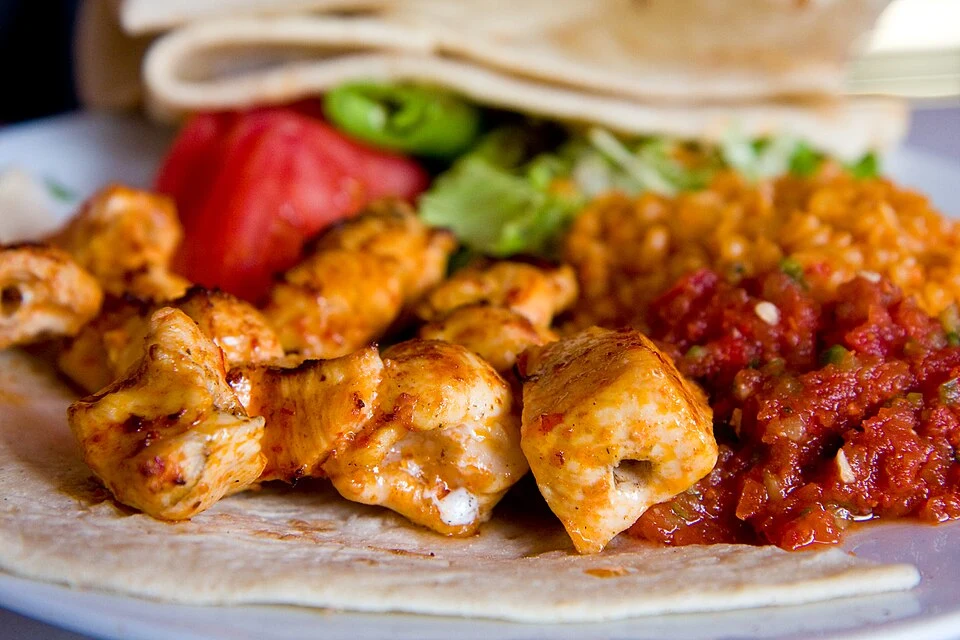
At The Glow Paradise, a health-food restaurant in Beirut, the latest argument about Lebanon’s economy comes wrapped in a flatbread. The establishment priced its “Chic Taouk” at about $13, almost twice the price of the traditional shish taouk, the Levantine grilled-chicken wrap. This version, however, was designed for calorie-conscious diners and branded with a playful new name.
The reaction was far less light-hearted, however. In 11 days, the restaurant said it had sold more than 20,000 sandwiches. Online, some people defended a business charging what its customers were willing to pay. Others saw the price as proof that ordinary life in Beirut had become unaffordable for too many people. Sami Nader, an economist at Beirut’s Saint Joseph University wryly remarked that lost in the hype around the popular eatery was a wider crisis in the food and dining scene: 22 other restaurants in the capital had closed the previous month. The debate struck a nerve because shish taouk is a basic dish in the regional pallet, a quick no-frills lunch. Turning it into a premium meal painfully exposed Lebanon’s wider financial divide.
The financial collapse that began in 2019 had already stripped the country of much of its economic resilience. By the end of 2024, real GDP had fallen by more than a third from its 2019 level. The World Bank says the crisis left the banking sector insolvent and cut the Lebanese pound’s value by 98%. These losses redefined what salaries, savings and public services could buy long before the latest menu dispute.
This was compounded by the 2020 Beirut port explosion. A joint assessment by the World Bank, UN and EU estimated that the blast caused about $4 billion in physical damage and another $3 billion in lost economic activity. The explosion hit a city already weakened by the financial collapse, damaging housing, transport and cultural assets.
On 8 October 2023, Hezbollah, the powerful Iran-backed militia, launched missiles against Israel, saying it was acting in solidarity with Hamas in Gaza. Israel responded with air strikes, the confrontation escalated over months. In September 2024, Israel upped the ante by decapitating Hezbollah’s leadership and weakened its chain of command. A month later, Israeli ground forces invaded southern Lebanon. A ceasefire was reached several weeks afterwards, but the economic damage had been done.
A March 2025 World Bank report estimated the cost of that conflict at about $14 billion and assessed that roughly $11 billion would be needed for recovery and reconstruction. Tourism, commerce, housing and agriculture all suffered, deepening the strain on a country short of capital and reliable public services.
There was a brief improvement in 2025, a year of relative quiet. The World Bank estimated that real GDP grew by 4.2%, helped by stronger consumption, investment and tourism. It was the fastest growth since the 2019 crisis. But the recovery had little room to absorb another security shock.
In March 2026, the spiralling Iran war reached Lebanon. After the United States and Israel struck Iran, Hezbollah fired rockets at Israel, calling it vengeance for the killing of Iran’s supreme leader Ali Khamenei and a defence of Lebanon. Israel targeted Hezbollah assets and leaders by air, later seizing several kilometres of territory in southern Lebanon, while hundreds of thousands of residents were internally displaced. The Shia militia had not sought the Lebanese government’s approval before acting, prompting the cabinet to reaffirm that decisions on war and peace belong to state institutions only.
The World Bank expects the economy to shrink by 6.4% in 2026 after renewed conflict damaged housing and infrastructure and weakened both tourism and domestic consumption. It also expects inflation to reach 17.5%, driven by higher oil prices, shipping costs and disruptions to supply chains. The banking sector, meanwhile, remains deeply crippled.
Food is where these pressures become personal. The price of a wrap is derived from the cost of its ingredients, staff salaries, restaurant maintenance and energy costs. In Lebanon, private generators cover gaps left by the national grid, and the bills arrive whether a family has eaten out or not. For September 2026, the Ministry of Energy and Water fixed the municipal tariff at about 53,000 Lebanese pounds (approximately $0.59) per kilowatt-hour, plus a fixed monthly charge depending on the connection. For an eatery, such costs are part of the calculation behind a menu. For a household, they compete with food, transport, medicine and school expenses.
The latest data clarifies the financial crunch facing Lebanese families. In September, UNICEF found that four in five households in Lebanon were struggling to afford basic necessities. About 22% said their children had gone to bed hungry, while 31% reported that children had missed necessary medical procedures, mainly because the family could not afford it.
Lebanon’s recovery will depend on more than restored stability. It will require banking-sector restructuring and fiscal management, more reliable public services and protection from another round of price shocks. Until those changes reach monthly budgets, the Chic Taouk will remain a small but telling sign of the distance between a popular lunch and what many households can afford.

Comments
JOIN THE DISCUSSION.