
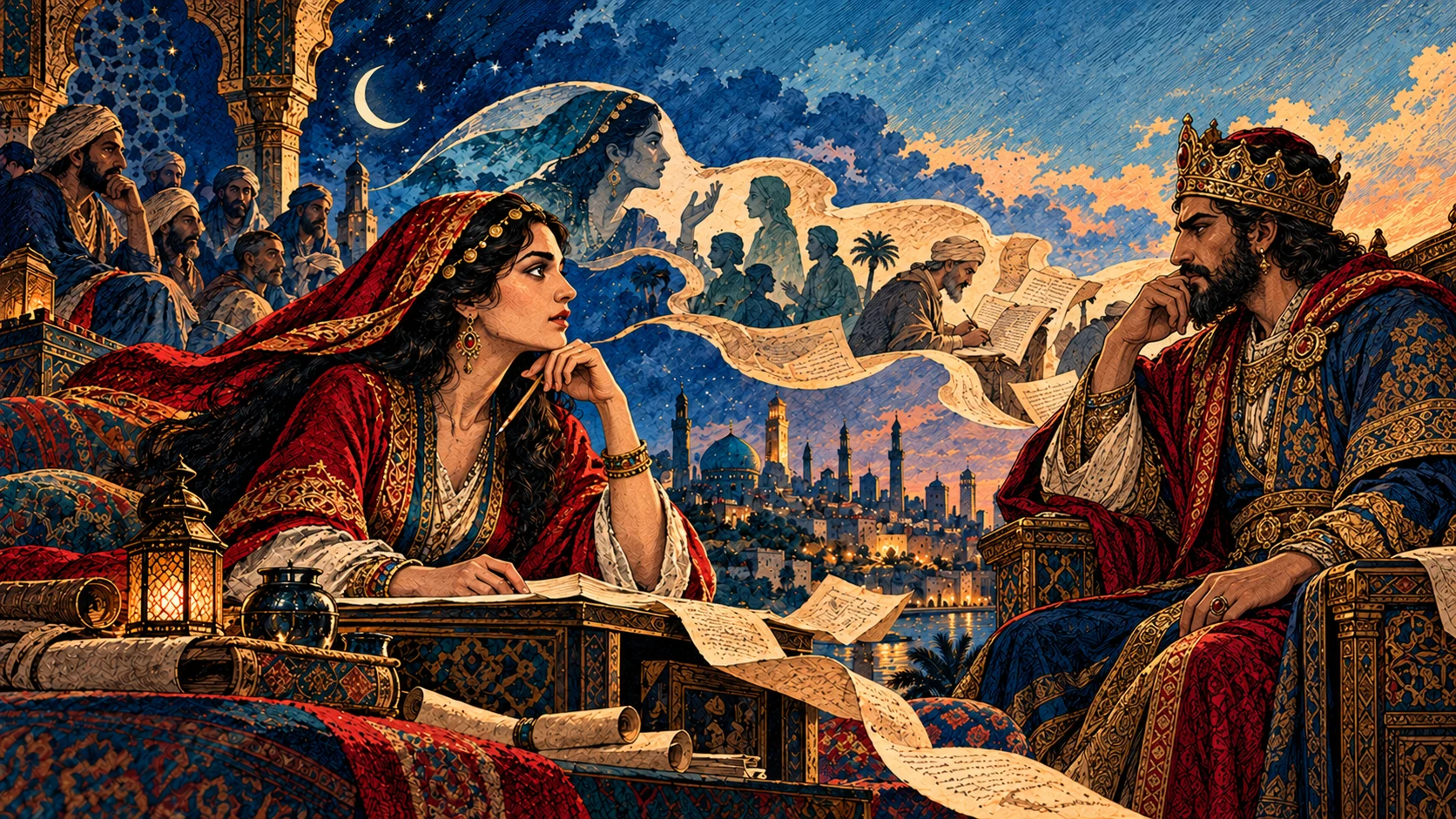
The defining association of One Thousand and One Nights should not be a magic lamp or a flying carpet, but the art of the perpetually unfinished story. Each dawn, Shahrazad, the work’s central narrator, breaks off mid-narrative, securing another night of life from her husband, King Shahryar, who executes his brides the morning after their wedding. This daily interruption is both narrative craft and a practical means of survival. It invites readers to read the collection not as a sealed treasure chest, but as a book built through delay, borrowing and revision.
In Arabic it is called Alf Layla wa-Layla, literally “A Thousand Nights and a Night”. The number was never a reliable table of contents. Before European translations, there were not necessarily 1,001 nights; Muhannad Salhi, the Library of Congress’s Arab World specialist, notes that the number may simply represent a large, indeterminate number of nights. The familiar label ‘Arabian Nights’ obscures the collection’s diverse origins. The tales draw on myriad traditions from China, India, Persia and Arab lands, and took shape in Arabic through a long process of transmission and compilation, including in medieval Baghdad, then the bustling capital of the Abbasid Caliphate. Some of the Baghdad tales mix historical names with fantasy. Caliph Harun al-Rashid, his vizier Ja‘far al-Barmaki and the poet Abu Nuwas appear alongside jinn, ghouls and a giant predator bird, the roc. The diverse collection includes fables, mysteries, romance tales, comedies, tragedies and horror stories.
The surviving manuscripts reveal just how much the collection evolved over time. The Bibliothèque nationale de France possesses the manuscript from the second half of the fourteenth century that Antoine Galland used as the basis of his French translation. Yet manuscripts copied in Egypt and Syria did not consistently preserve the same stories, and no single definitive text commands agreement. A tale could pass from a performer’s voice to a scribe’s hand, from one city’s copy to another city’s compilation.
That circulation gave the most familiar figures a less familiar genealogy. Galland began publishing his adaptation in 1704. It grew to twelve volumes, the last of which appeared in 1717, two years after his death. When his Arabic manuscript did not supply a full sequence, he drew on stories told by Hanna Diab, a Maronite traveller from Aleppo. Both Ali Baba and Aladdin, the latter routinely presented as the heart of the “Arabian Nights” through the globally popular Aladdin films of 1992 and 2019, were not featured in the earlier Arabic manuscripts from which Galland began. These protagonists entered global print through a meeting between a French Orientalist and a Syrian storyteller.
Sinbad the Sailor was Galland’s first point of entry into the collection, which he translated separately before turning to the main manuscript. In the frame story, a poor porter named Hindbad hears music and smells food outside the Baghdad house of a wealthy man called Sinbad the Sailor. Sinbad recounts his seven voyages, filled with shipwrecks, monsters and encounters along Indian Ocean trading networks. The character eventually migrated into global multimedia, appearing in films, animation, comic books and video games.
Galland’s version also made the collection legible to European taste. The French national library records that he cut verse and passages judged too licentious. It also notes more than 80 reissues, translations into about ten languages and numerous pirated editions. Ultimately, the success of these editions helped turn Shahrazad, Sinbad and Aladdin into shorthand for an imagined Orient. Through successive adaptations, palaces, veils, genies and bazaars became stock images through which Western audiences pictured a vast and varied region, first in art and literature and later in Hollywood and Disney films.
In the written tradition, copying and compiling decided which tales travelled. In 1835 Cairo’s Bulaq Press produced what is usually described as the first complete printed Arabic edition. Earlier editions, in Calcutta (1814–18) and Breslau, Prussia (1825–1845), had covered only part of the collection. It was a major shift after centuries in which the corpus changed through oral and manuscript circulation. Print gave readers a durable object, but it also narrowed a field of variants into an edition that subsequent readers could treat as the book.
The printing press stabilised one version of the collection, but it did not end its reinvention. The title and its stories continued to circulate in modern music and fiction. In 1969, Umm Kulthum recorded Alf Leila wa Leila, with lyrics by Morsi Gamil Aziz and music by Baligh Hamdi. The song does not retell Shahrazad’s stories, but instead uses the familiar title in a love song. In 1982, Naguib Mahfouz, the famed Egyptian writer and later Nobel laureate, published Arabian Nights and Days, drawing on its characters and setting them in a city marked by corruption, social unrest and rival religious groups. Genies remain in the story, but so do police, rulers and political struggles.
Popular fascination surrounding the book continues to this day. In February 2026, the Abdul Hameed Shoman Cultural Forum in Amman launched Jordanian novelist Shahla Al-Ajaili’s Hanna Diab’s Room, set in Aleppo and centred on the storyteller whom the forum described as long marginalised by literary history. The same spring, the Louvre-Lens mounted “Beyond the Thousand and One Nights”, an exhibition of nearly 300 works examining how objects and European images of “the Orient” have circulated and hardened into stereotypes. One project returns an Aleppine voice to the story; the other asks Europe to account for the images it made from it.
Shahrazad survives by refusing to deliver a final answer before morning. In its own way, her collection has endured through a similar refusal of closure. Long before modern audiences binge-watched episodes of a Netflix series, or nineteenth-century readers eagerly consumed the latest instalment of a serialised novel in their local newspapers, One Thousand and One Nights understood the human craving for suspense. Its capacity to captivate ensures it will continue to inspire global storytelling for generations to come.

Comments
JOIN THE DISCUSSION.