
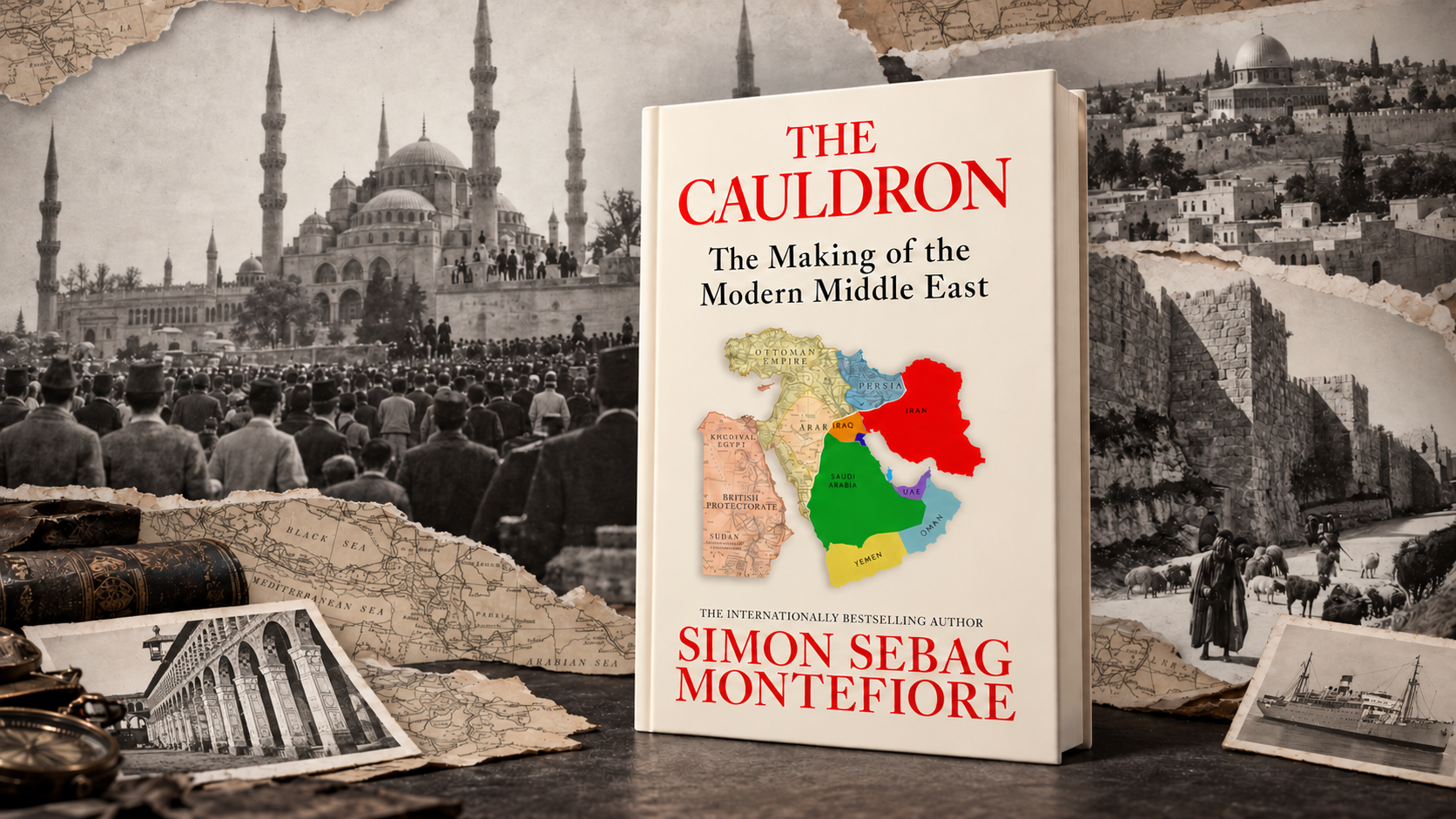
Grand histories of the Middle East are often constructed around a tempting villain. Sykes–Picot, say, or Israel, or oil, or Islam itself. Simon Sebag Montefiore, a British popular historian and journalist best known for Jerusalem and his histories of Russia, refuses that temptation. Montefiore’s latest work, The Cauldron, covers the history of the region from Ibn Saud’s seizure of Riyadh in 1902 to the killing of Ayatollah Khamenei in an Israeli-American air strike in 2026, part of what Montefiore calls the “Third Gulf War”. In between come the collapse of the Ottoman Empire, postwar-League of Nations mandates, Arab nationalism and Zionism, countless coups and counter-coups, the Iranian revolution, two earlier Gulf wars, the Arab Spring and its long unravelling.
Montefiore divides his story into two acts, hinged on the pivotal year of 1979. The first belongs largely to empires and their wreckage: sultans, pashas, kings and proconsuls, followed by the states assembled during the post-Ottoman era. The second opens with Ayatollah Khomeini and the rise of revolutionary Islamism. Montefiore treats Iran’s revolution as “a world-changing epochal moment as significant as 1789 and 1917”. That puts Iran, rather than the Israeli–Palestinian conflict, at the centre of recent Middle Eastern history. An unfashionable choice, yet a persuasive one.
“Simplification is always the enemy of history,” Montefiore writes. Britain and France did not simply draw some lines after the First World War and thereby doom a century to conflict. Nor does American intervention, energy resource, the Arab–Israeli conflict or the Sunni–Shia divide explain enough on its own. Instead, Montefiore presents the region as the product of overlapping contests between empires and nations, secularists and pious, majorities and minorities. His focus is not limited to Muslim Arabs; Persians, Turks, Kurds, Jews, Armenians, Copts, Maronites and Alawites all belong to the story, and three of the region’s most formidable states today — Iran, Israel and Turkey — are not Arab at all.
Montefiore deliberately opens not with the Young Turks or the Balfour Declaration but with a small, dusty raid: Ibn Saud and a band of followers retaking his family’s ancestral seat in Riyadh. It shifts the reader’s gaze from the Levant towards Arabia while making a larger point: Middle Easterners have agency in this story.
Outsiders nevertheless remain busy throughout. Britain and France divide Ottoman spoils; the United States and Soviet Union transform the region into a Cold War arena, with America ultimately becoming its dominant external power. But Gamal Abdel Nasser, Mustafa Kemal Atatürk, Muhammad Reza Pahlavi, Saddam Hussein and Hafez al-Assad are not simply acted upon. They manipulate patrons, launch wars, miscalculate and repress on their own account. Imperialism explains a great deal, but it does not let anyone else off the hook.
This is clearest in the transition from empire to nation. It has become trendy to mourn the Ottoman Empire as a lost cosmopolitan order, undone by European interference and intolerant new nationalisms. There is something to that: Alexandria, Salonica, Baghdad and Beirut were once home to a diversity of peoples now largely vanished. But the empire’s final decades also brought expulsions, massacres and genocide, most catastrophically against the Armenians. Through these tragic events, alongside migrations and population exchanges, much of the diverse ethno-religious mosaic that characterised the centuries-long Ottoman dominion disappeared. The modern Middle East was made not only by drawing new borders but, in places, by making the populations within them more alike.
The book’s great asset is its cast. Montefiore has a novelist’s eye for characters and a journalist’s appetite for memorable phrases. The encounters can be wonderfully absurd. When Churchill met the austere Ibn Saud in 1945, he was warned that neither smoking nor alcohol was permitted in the king’s presence; the aging British premier replied that his own way of life practically required both. The Saudi regent graciously yielded. The Shah of Iran, meanwhile, complained that America treated him “like a concubine not a wife”. Montefiore labels the strange collision of ancient warrior culture and cheap modern technology “iPhone-and-dagger societies”. History here feels less like the grinding of impersonal forces than the work of people who slept too little, hated their rivals and occasionally reshaped the map out of pique.
This is also the book’s chief weakness. Personalities stay vivid; structures — demographics, institutions, oil rents — sometimes blur past. Readers may remember a dictator’s mistress more easily than the balance-of-payments crisis that put her lover out of power. Nobody covering Morocco, Iran, Saudi Arabia and Turkey in one volume can offer a specialist’s depth on each. The surprise is how often Montefiore gets away with it.
There remains a problem with the title. A “cauldron” implies a place naturally disposed to boil over, and the book supplies plenty of ammunition for that reading: coups, massacres, revolutions, three Gulf wars. Yet this framing risks smuggling back in precisely the assumption Montefiore’s own material undermines — that the Middle East is condemned to exceptional turbulence, as though violence there sprang from the soil rather than from processes familiar elsewhere.
Collapsing empires, rival nationalisms, forced population transfers, ideological revolutions and great-power intervention convulsed Europe too, and South and East Asia besides. What distinguishes the Middle East may be less that it suffered these forces than that so many of them overlapped, went unresolved and kept getting internationalised.
Nor did these forces operate uniformly across the region. Oman’s twentieth century looks nothing like Lebanon’s; Tunisia’s nothing like Iraq’s. The book’s enormous range raises an awkward question: what, beyond convention, makes Morocco, Israel, Yemen, Turkey and Iran a single story called “the Middle East”?
Montefiore himself has begun to wonder whether the term has outlived its usefulness. In a recent excerpt from the book, he argues that the expression “Middle East” is becoming increasingly inadequate as the region converges with the Caucasus, South Asia, Africa and the wider Mediterranean. His narrative supplies its own answer regardless: interconnection. Empires crossed the region; Judaism, Christianity and Islam emerged from it; oil made distant deserts central to the world economy; the Palestinian cause reverberated from Rabat to Tehran. He notes that Shia Iran helped give the Sunni Arab world one of the defining forces of the post-1979 order: "radical Islamist–nationalism”. Fair enough. But interconnection is not sameness — a distinction the book rarely allows its enormous geographical sweep to obscure.
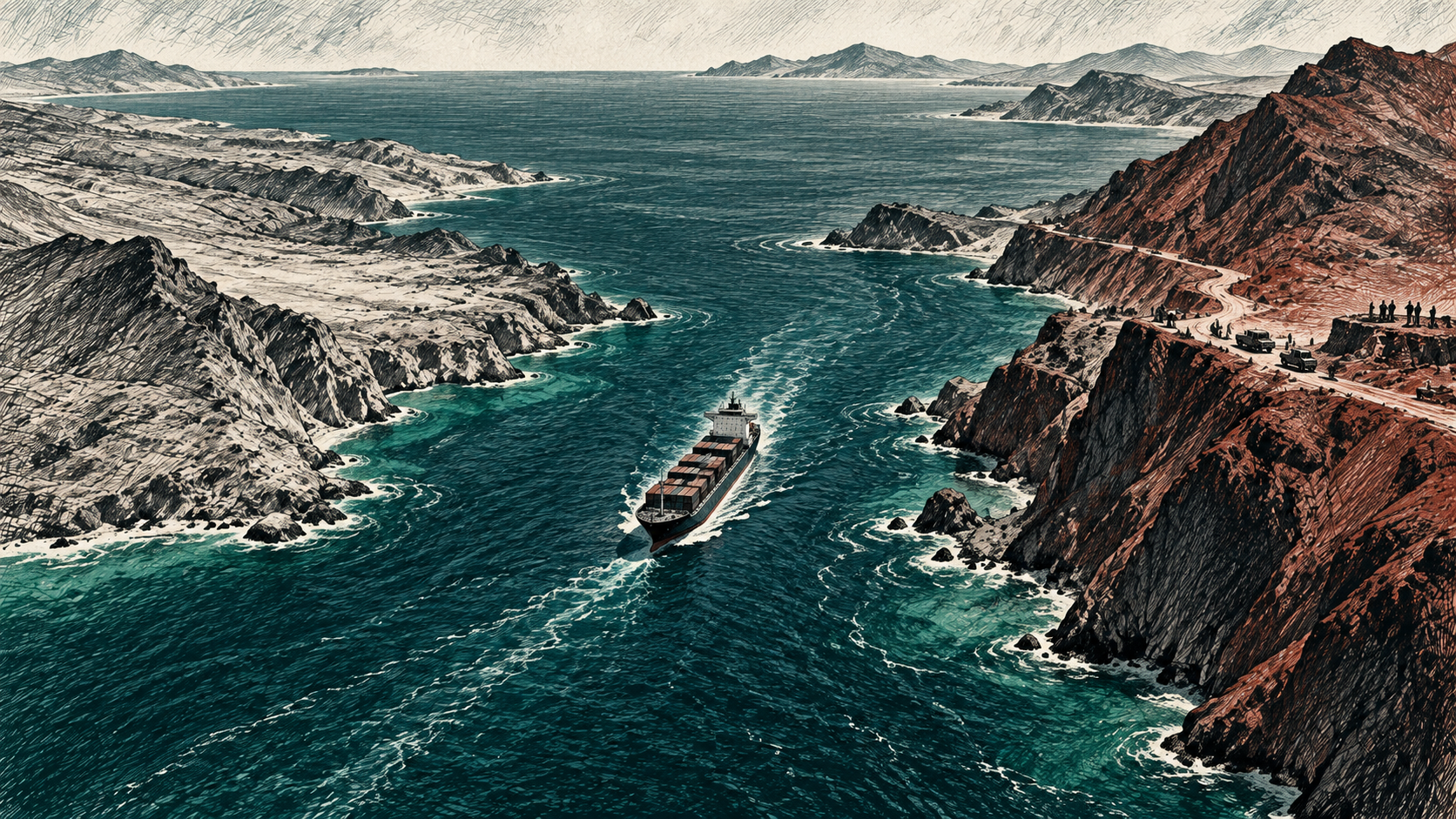
The closer the narrative creeps towards the present, the shakier the historian's footing becomes. The events of October 7, the Gaza war, Bashar al-Assad's fall and the strikes on Iran sit somewhere between history and journalism; archives remain closed, and today's apparently epochal turn may look minor in twenty years. Yet Mr Montefiore is alert to shifts that already seem consequential. Saudi Arabia, he argues, has displaced Egypt as the Arab world's leading Sunni power, even as the Houthis show how a comparatively weak paramilitary force can frustrate far richer and stronger states.
Israel and the United Arab Emirates, meanwhile, have aligned against Iran through a robust partnership that would have seemed unthinkable not long ago. Mr Montefiore regards Israeli peacemaking with all its neighbours, Palestinians included, as essential to the country's own well-being, and argues that Palestinians in turn must help a traumatised Israeli public see the possibility of coexistence and accept their place in the region. Israelis, in its turn, should allow for the possibility of a "peaceful Palestinian entity on their borders." Turkey, he asserts, has embraced neo-Ottomanism under Recep Tayyip Erdoğan, envisioning Turkish hegemony in the Levant that, taken to its logical end, could invite war with Israel through its threats against the country — and, ironically, unwind Ankara's historic role as a Eurasian power.
A book published in 2026 forfeits the historian’s usual luxury: distance. That is also why it earns its keep now. “Ignorance is the father of righteous certainty,” Montefiore writes, and few regions attract more of it. Outside spectators turn the Middle East into a screen for arguments about colonialism, nationalism, race and religion cooked up elsewhere. The Cauldron is at its best when it refuses to co-operate: Western powers have done real damage but are not omnipotent; religion matters but is not the sole force dictating behaviour; borders matter but cannot alone explain what happened inside them; victims can become perpetrators, minorities can become majorities and revolutionaries can become rulers. None of this yields a tidy master theory. That, in the end, is the point.
Montefiore has called his Middle East a cauldron. A better image emerges from his own 528 pages: a region where histories pile up rather than clear away — Ottoman under Arab, Turkish and Persian; empire under nation; religion under secularism. New orders keep getting built on old grievances without ever quite burying them.
The achievement of The Cauldron is not to have finally explained the Middle East. No single book could. It is to make clear that anyone claiming otherwise should be regarded with some suspicion.
The Cauldron: The Middle East Behind the Headlines, by Simon Sebag Montefiore. Weidenfeld & Nicolson, 528 pages
Comments
JOIN THE DISCUSSION.