
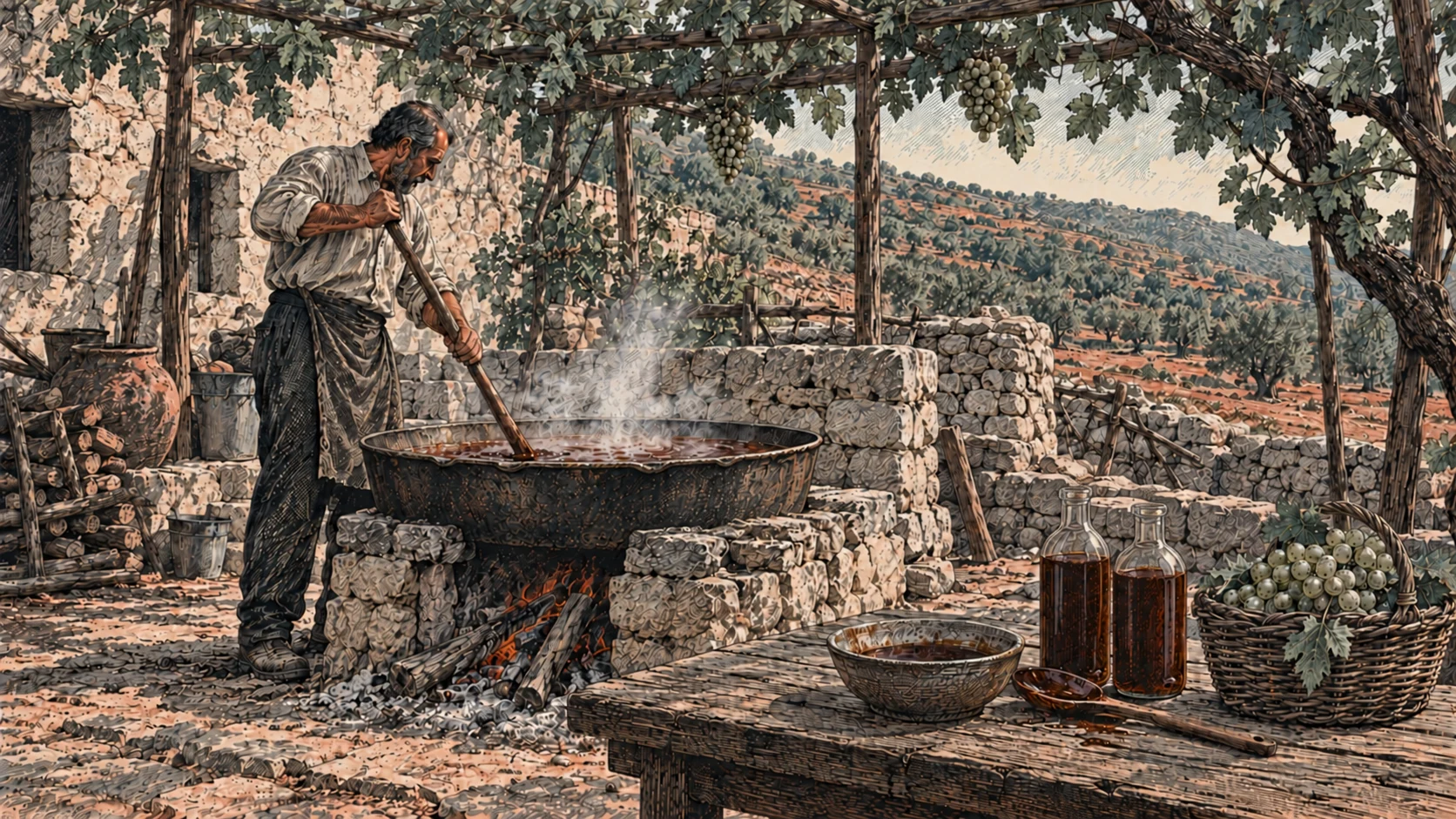
Every autumn, villagers in the eastern Mediterranean gather beside huge cauldrons outside their homes to turn grapes into syrup. The names vary: dibs al-anab in much of the Levant, pekmez in Turkey, doşab in Azerbaijan and Armenia, petimezi in Greece, epsima among Greek Cypriots. The names differ, but the method is much the same: grape juice is boiled down into a thick, sweet syrup.
Around Hebron, the West Bank’s largest city, dibs (as it is usually shortened) has been made for centuries. The method is simple. The fruit is crushed and the juice strained through burlap or canvas bags, then traditionally mixed with white earth, which removes acidity and impurities. After a day’s rest, the juice goes into a large cauldron over a slow wood fire. About three-quarters of the way through, the bubbles on the surface swell and turn glossy, like “the eye of a camel”, as villagers there often put it. Seven or eight hours later the liquid has become a golden syrup that darkens as it cools. No sugar is added. About a third of the juice’s original volume remains: a kilogram of dibs takes four to five kilograms of fresh grapes.
Grape syrup is ancient. The Greeks made it as epsima, a sweetener cheaper than honey. The Romans boiled must (unfermented grape juice) down to half its volume to make defrutum, and to a third to make sapa. Around 1370 Rabbi Joseph Tov Elem, who lived in Jerusalem, suggested that the “honey” in the Bible’s “land flowing with milk and honey” was really grape syrup. That is plausible: all the ingredients were in the region in antiquity, when date honey is also known to have been produced. Byzantine presses for making grape molasses, similar to those known from later periods, are attested near Mount Hermon. Grape molasses also appears in a text dating from the same era found at Nessana, in the Negev Desert, a city also known for the production of Gazan wine.
Nevertheless, it was the rise of Islam that did most to boost dibs’s popularity. Islamic law forbids wine, and under the Mamluks, who ruled Egypt, the Levant and the Hejaz from 1250 to 1517, the ban was strongly enforced, at least periodically. Dibs mixed with water became a substitute for forbidden wine, and vineyard owners on the terraced hills throughout the region are said to have turned from fermenting to boiling. In 15th century Syria, hashish users mixed it with dibs to temper the drug's effects. By the 19th century, Hebron was shipping the syrup to Egypt.
Yassir Sa’adah, a farmer from Halhoul, a Palestinian town just north of Hebron, prefers, like many others in the broader Middle East, to mix dibs with tahini, a sesame paste, as a dip for bread. He makes it for his children on cold winter days, he says, so that their bodies warm up and their faces flush red, and so that they stay strong and healthy through the winter. Like honey, it is mostly sugar, at around 290 calories per 100g.
In nearby villages dibs sits on the stalls of older women and teenage sellers alike, beside jars of labneh and maqdous (oil-packed stuffed baby aubergines). Dibs is also one of the most common ingredients in jallab, a refreshing drink consumed in summer and upon breaking the fasts of Ramadan. Malban (grape roll up), another dibs-derived snack, is made by adding nuts and semolina or wheat, then drying the mixture in the sun. At the Dura Cooperative Food Processing Association, near Hebron, women make it from surplus grapes, along with malban, anabiyyeh (a grape preserve), vinegar and preserved vine leaves, all of which can be stored and sold through the year.
In Lebanon, dibs was long used in villages in place of sugar and went into meat stews, lending a grape flavour. Today it mostly sweetens desserts, competing with carob syrup and honey. A 2024 study in Lebanon checked 30 samples and found real differences in taste and quality, depending on the type of grapes and the method of production. The lack of a formal standard across the country is said to hinder exports. Not everything sold under the name is as plain as the village version: the label on one commercial brand lists sugar, citric acid and caramel colouring beside the grape concentrate.
Grapes and their syrup matter especially in Rashaya, a mixed Druze–Christian town in Lebanon’s Beqaa Governorate, also known for its red-roofed, cobbled alleys. Production there has been mechanised. Locally built electric presses squeeze the fruit, and the juice runs into stainless-steel or galvanised tanks rather than basins cut into rock. The juice is left for eight hours with hawara, a white limestone earth that draws out acidity and helps sediment settle. The pomace goes under a piston press rather than between stone rollers. The clear juice is then boiled in copper vats for just over an hour, and skimmed, until it is reduced to a fifth of its volume.
Each October Rashaya holds Yawm el-Dibs (Grape Molasses Day). The streets are hung with artificial grapevines, musicians play the oud and guitar and youngsters perform the traditional dabke dance. In 2025, the festival’s seventh year, around 20,000 visitors made the trip to the town, 1,350 metres above sea level, to sample molasses and local honey and to buy handicrafts. The main attraction was a Lebanese flag 300 metres long, which the municipality believes may earn a place in the Guinness World Records.
In southern Syria the syrup is a livelihood as well as a custom. Sweida, a mountainous governorate with nearly 10,000 hectares of vines, is Syria’s leading producer. The area is dominated by Druze, who, like Muslims, avoid wine. Most syrup is still made at home, though mechanical presses are spreading; the season runs from September to the end of October. As of 2026, dibs was produced from 14% of the regional grape harvest, and around 75 presses are documented, though production is endangered by rising costs. In the Qalamoun area, not far from the capital, Damascus, 60% of the grapes go to raisins and dibs. Climate change, drought and rising costs have cut output.
North, in the western-central Syrian city of Homs, another sort of dibs is made: dibs az-zbib, or raisin molasses. Production starts in December, when raisins are crushed and soaked in containers for up to three days; the liquid is then filtered and cooked for three hours. A kilogram of syrup takes only one to one and a half kilograms of raisins, which are far more concentrated than fresh grapes. As of 2026, around 25 presses remain in the region. Across the border, in the Lebanese Christian village of Ras Baalbek, raisin molasses is also produced; presses are still turned by donkeys.
Further west, on the island of Cyprus, the syrup has faded from daily use. Until the mid-20th century grape molasses was one of the island nation’s main sweeteners. It was kept in clay jars, later in glass, through the year. In the Marathasa valley, in the Troodos mountains, it sweetened local cooking for centuries. According to the Cyprus Food Museum, cooks scented it with rose geranium or basil and mixed it with flour or wheat to make puddings and dried sweets, which farmers ate during the working day. Apples and quinces were cooked in it, in a dish called retsellia that some regard as a forerunner of spoon sweets (fruit preserved in syrup and served by the spoonful).
In Greece, where the grape version is sometimes called “the honey of the poor”, petimezi replaces sugar syrup in spoon sweets and goes into biscuits and other baked goods. One such dessert is the petimezopita, an aromatic cake popular in the Aegean that combines grape molasses with olive oil and warm spices such as cinnamon, cloves and nutmeg.
In Turkey, pekmez is mostly made from grapes, but nearly every region has its own name and style: zile in Zile, ağda in Gaziantep, çalma in Kırşehir, bulama in Balıkesir, masara in Kahramanmaraş. In the east, as in neighbouring Azerbaijan, mulberries are common, prized for their iron; others use carob, figs and pomegranates. Turks enjoy it by the spoonful, swirled into tahini or baked into pekmezli un helvası, a flour halva. Most rural producers still boil it the traditional way, in the absence of the vacuum evaporators used by larger ones.
Though molasses continues to be praised throughout the region, not everyone is sold on the ancient tradition. One visitor to the festival in Rashaya admits, with a sheepish smile, that he is there only for the atmosphere. Why, he wonders, would anyone need dibs when a chocolate bar is always within reach? Fadwa Barakat has an answer. She comes from a village near Baalbek, in Lebanon, whose dibs was noted in the 14th century by Ibn Battuta, the famed Moroccan explorer. “If people knew the syrup’s benefits”, she says, “many diseases would disappear”: a bold claim for a sweetener. “Without dedication, the taste will fall flat,” she adds, lamenting that grape molasses is now made in concrete basins rather than the rock-cut ones her ancestors used. “Making dibs is a blessed part of our heritage. I hope we pass it down to the new generations.”

Comments
JOIN THE DISCUSSION.