
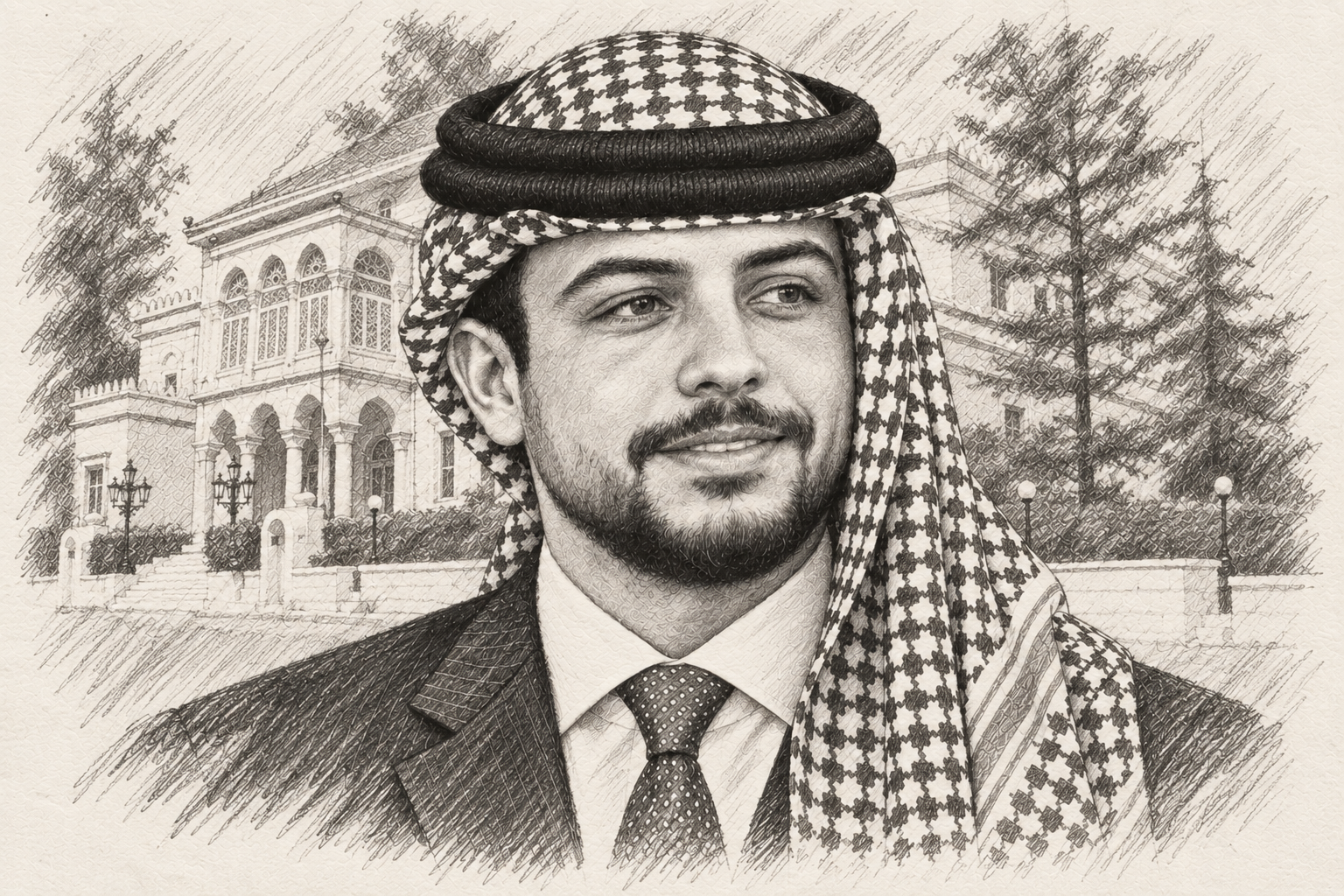
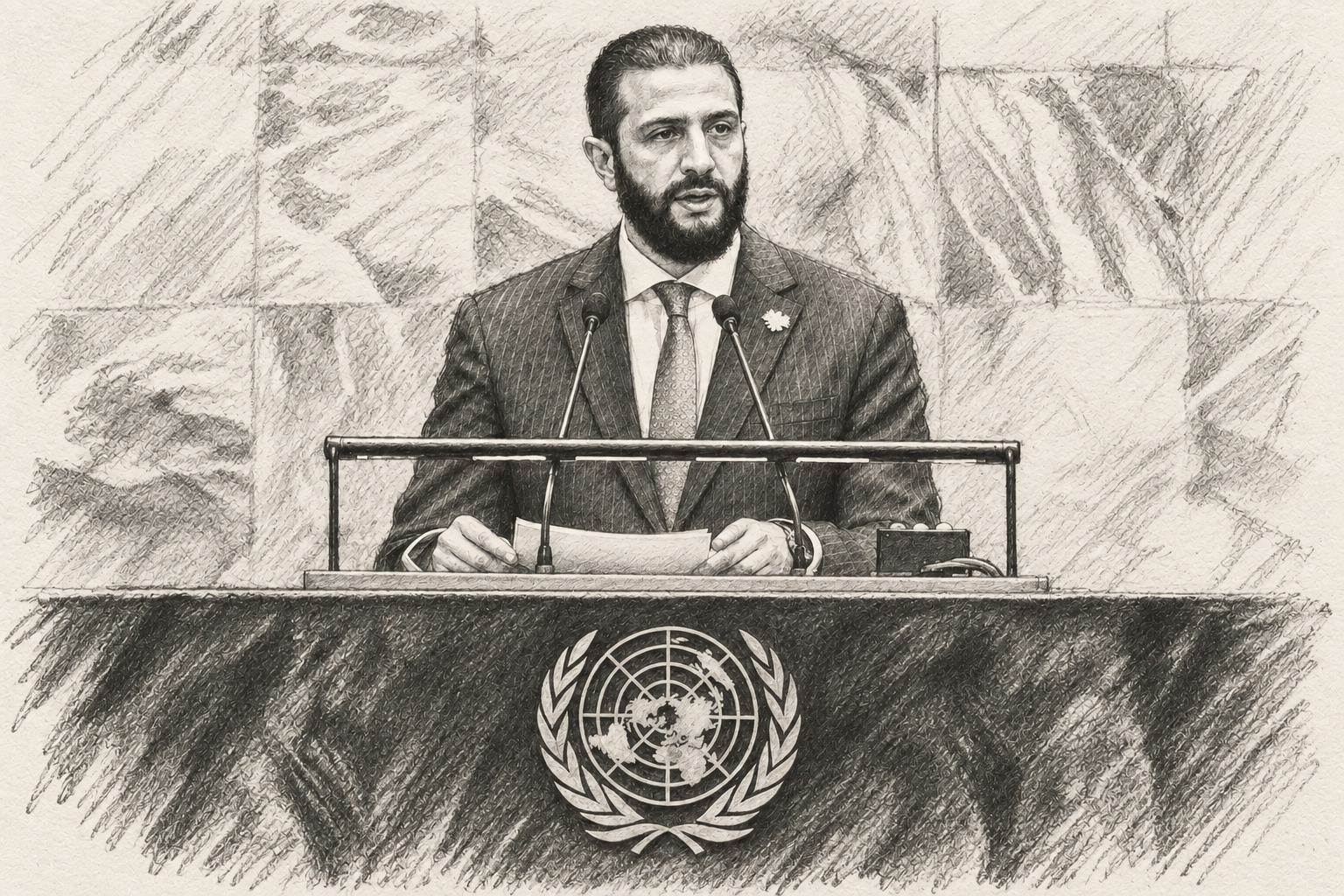
Jordan’s King Abdullah II was among the many foreign leaders to address the United Nations General Assembly’s 81st session in New York. While the monarch’s UN visit was headlined by his impassioned speech criticising Israeli actions in the West Bank and southern Syria, a more telling dynamic in Jordanian policy could be found in his entourage. Co-chairing Amman’s delegation and intimately attending meetings with foreign dignitaries on the UNGA sidelines was Abdullah II’s eldest son, Crown Prince Hussein.
The 32-year-old heir-designate joined his father in talks with European Council President António Costa and leaders of countries including Canada, Finland, Ghana and Barbados. He also represented Jordan without his father in attendance in corporate and diplomatic parleys, discussing ride-sharing expansion with Uber CEO Dara Khosrowshahi, intellectual property and artificial intelligence regulation cooperation with Opens Haven Technologies head Hamza al-Sarhan, and Palestinian humanitarian conditions with Irish Taoiseach Michael Martin.
The crown prince’s UNGA appearance was a portrait in miniature of his trajectory in public life over the past decade: a rising, closely supervised expansion of his footprint in Jordanian policymaking on the world stage, closely aligned with his father — and increasingly carrying out this vision in his own capacity.
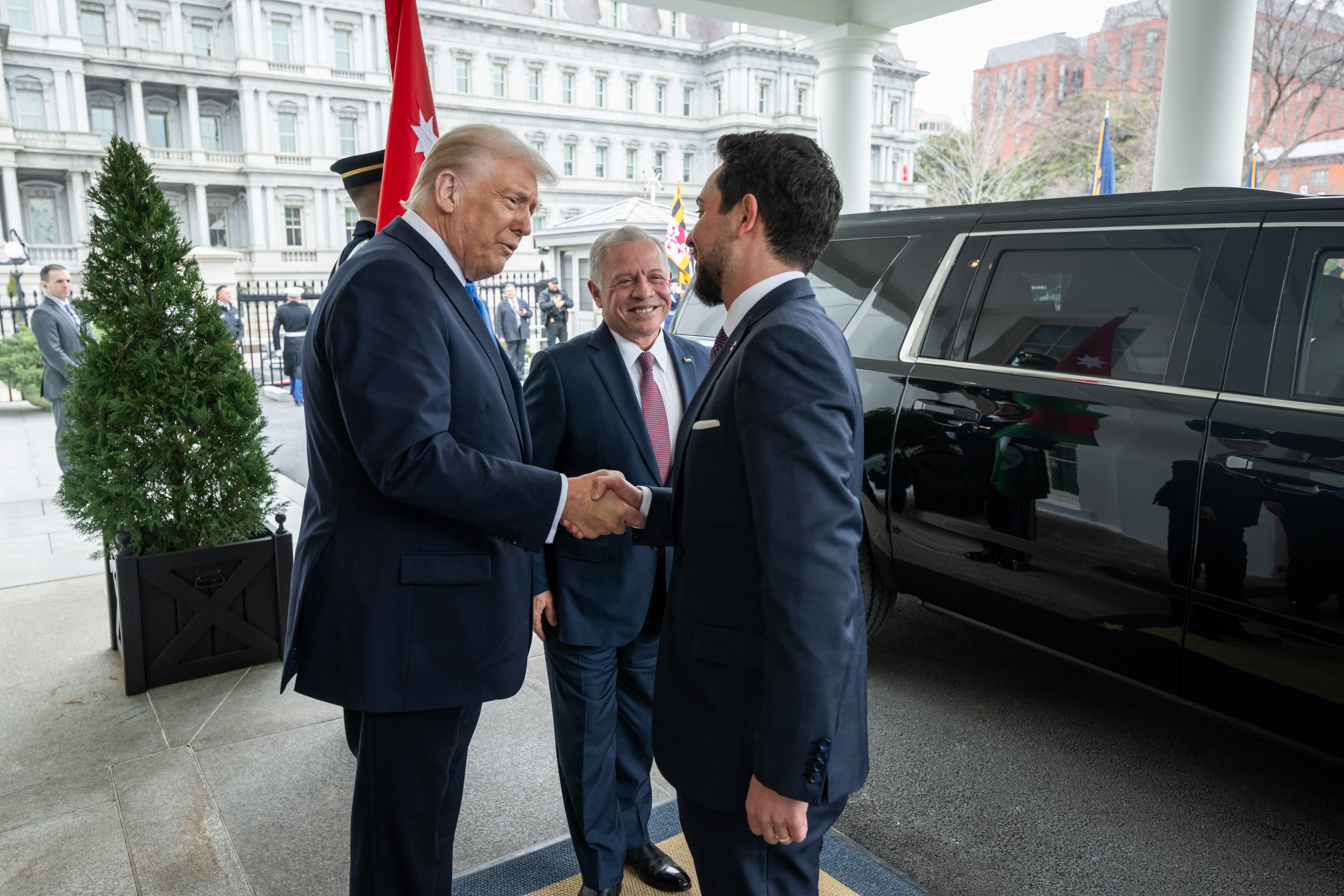
It is only the latest in a string of high-level engagements alongside the king. In February 2025, Crown Prince Hussein accompanied his father on a state visit to Washington, joining President Trump in meetings addressing the future of Gaza and the West Bank, followed by engagements with congressional leaders. This was his third time at the Oval Office, having met with President Biden a year earlier and in 2021. Just over a week before this year's New York parley, Hussein visited Abu Dhabi and discussed regional developments with UAE President Sheikh Mohamed bin Zayed.
The joint appearances go back further still. At the 2023 UNGA, a 29-year-old Crown Prince shadowed his father for a week in high-level diplomatic interactions, including with the World Bank President Ajay Banga and World Food Programme chief Cindy McCain. Before departing for the 2024 UNGA, Crown Prince Hussein’s official status was upgraded: King Abdullah swore in his son as Regent, leaving him to govern at home for the duration of the trip — a now-familiar arrangement that has recurred, most recently, in August 2026, ahead of the monarch’s weeklong visit to China.
The heir-designate’s current visibility is the product of nearly two decades of deliberate preparation. He was declared first in line to the Jordanian throne at the age of 15 in 2009, through a royal decree elevating him over his half-uncle and once heir-apparent Prince Hamzah. The son of the late King Hussein and American-born Queen Noor, Hamzah had himself been stripped of the crown prince title back in 2004 by King Abdullah II, who himself rose to power following King Hussein’s death in 1999.
The Hussein–Hamza relationship was further strained in April 2021, when Hamzah was placed under house arrest over his alleged role in a plot to destabilise the kingdom; a close associate, Bassem Awadallah, was later convicted of sedition. Hamzah never regained prestige within the family hierarchy and renounced his princely status in April 2022, arguing that his outlook no longer aligned with Jordan’s institutions. Henceforth, there has been no ambiguity about the line of succession.
Crown Prince Hussein’s training for succession has been prudently structured since his 2009 designation. He moved to America’s capital after high school to earn his bachelor’s degree in international history at Georgetown University. He then spent a year undergoing officer training at Britain's Royal Military Academy Sandhurst, where his father and grandfather once trained. Crown Prince Hussein has cultivated his Sandhurst ties to solidify relations with fellow alum Prince William of the UK, as part of a broader network of royal family heirs. The crown prince first grew close to William during his 2018 tour of the Middle East, hosting the visiting prince in Amman for two days. William and Kate returned as guests of honour at the Crown Prince's June 2023 wedding, and the friendship has continued through reciprocal visits, including a private stop by Hussein and Rajwa at Windsor Castle.
His highly-covered marriage to Rajwa Al Saif, a Saudi-born architect and fellow American-educated university graduate has taken on the aura of a celebrity couple, with the two’s photogenic persona bolstering their image as cool but mature young leaders. Al Saif’s mother, Azza, hails from the prominent Al Sudairi branch of the Saudi royal establishment — leaving many observers to see the marriage as advancing the dynastic alliance between the Hashemites and the Saudis as much as two people falling in love. The couple's first child, Princess Iman — named for the Crown Prince's sister — was born in August 2024, making King Abdullah and Queen Rania grandparents for the first time. The heir-designate subsequently has capitalised on his fatherhood to cultivate a regional profile of a loving and responsible parent gaining valuable life experience to complement his professional credentials.
In the modern, social media-dominated information environment, Crown Prince Hussein has sharpened this distinctly Gen Z-facing public persona — fluent in English, comfortable on Instagram, and, by his early twenties, already commanding a social following in the millions. Analysts have compared him to Saudi Crown Prince Mohammed bin Salman for his ability to speak the language and understand the sensibilities of the Arab world’s younger generation. MBS's rise, however, was marked by abrupt, high-risk moves with few internal pushbacks — the 2015 military intervention in Yemen and the 2017 blockade of Qatar. In contrast, Crown Prince Hussein received authority incrementally and under close management. His early-career portfolio has been modest, chairing a UN Security Council session and gradually taking on solo diplomatic assignments, rather than sweeping unilateral initiatives with irreversible consequences.
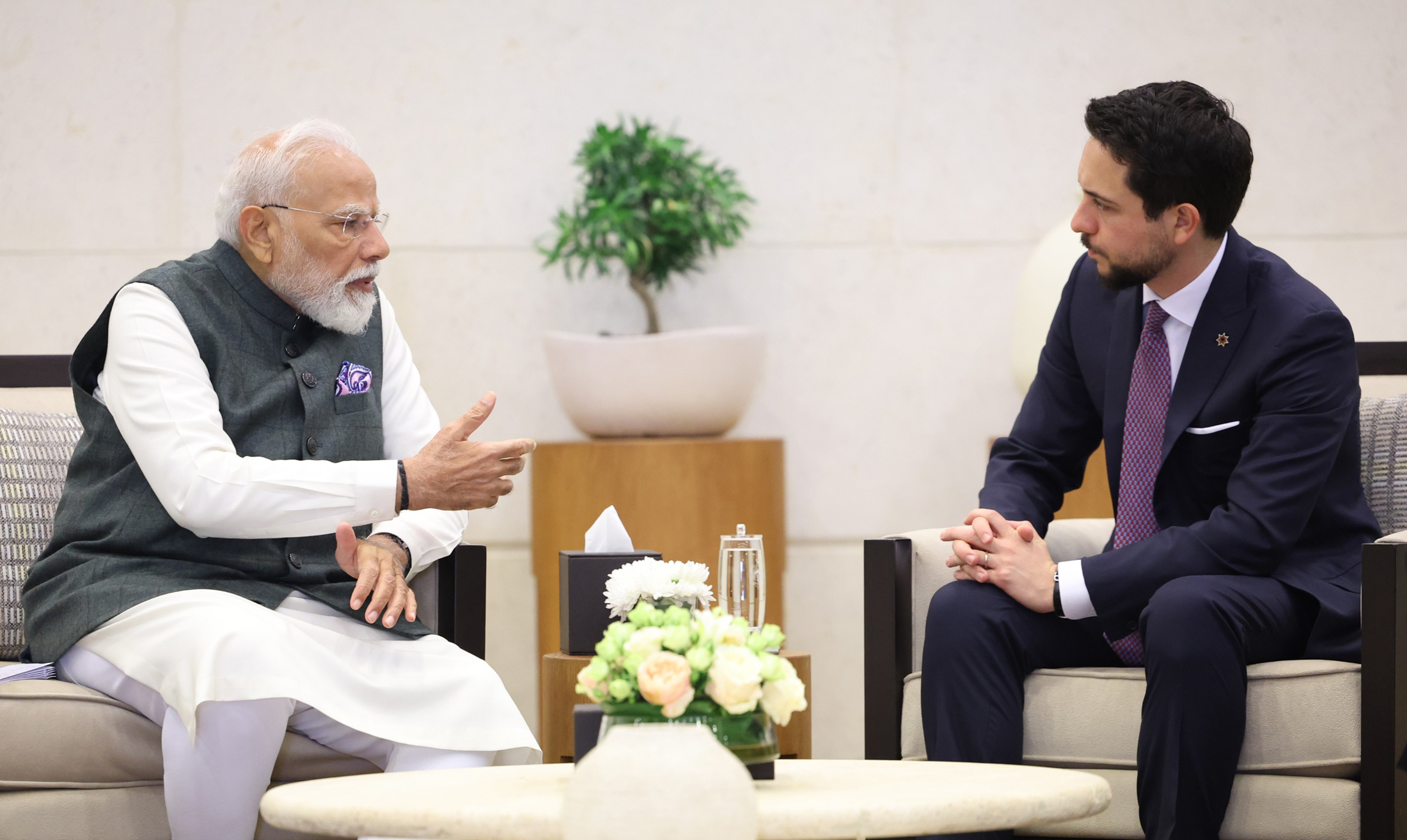
The prince’s gradualism is most visible in a growing list of engagements that he handles entirely on his own. In October 2025, he travelled to Paris with only Princess Rajwa at his side, meeting French President Emmanuel Macron at the Élysée Palace. He met Macron again in solo capacity the following April, at an informal EU meeting with regional partners in Cyprus. In May 2026, he received the EU's commissioner for the Mediterranean, Dubravka Šuica, and met with Germany's Minister for Economic Cooperation and Development Reem Alabali Radovan, discussing vocational training and Jordan’s National Water Conveyance. In September 2025, well before this year's UNGA, he held private meetings with ranking members of the US Senate Foreign Relations Committee, conducting diplomacy once reserved entirely for the king.
Increasingly, the Crown Prince has also become the face of Jordan's international branding. Days before this year's UNGA, he hosted travel influencer Joe Hattab at Raghadan Palace in Amman to launch a tourism campaign showcasing Petra, Aqaba, and the Dead Sea to a global audience. As such, he can be seen as following in his father’s footsteps of soft power projection from his 2002 appearance on The Royal Tour travel series, albeit updated for a contemporary audience. He and Princess Rajwa prominently appeared alongside his father at the 2026 World Cup matches in the US to cheer on Jordan's football team, deliberately pairing the monarchy's continuity with a moment of national pride.
The 64-year-old King Abdullah II is mindful that his father passed away at 63, after a long battle with cancer. He also presciently observes historical challenges to the monarchy since its 1946 establishment, with his grandfather assassinated in 1951 and his father’s throne nearly collapsed during his 1970 conflict with Palestinian insurgents during the so-called “Black September”. The collapse of fellow Hashemite monarchies in Syria and Iraq reinforces Abdullah II’s perception that his kingship cannot be taken for granted. Against that history, the transition from father to son is being managed deliberately — less as a rupture than as a gradual transfer of responsibility, with Hussein accumulating experience in leadership, diplomacy and decision-making under his father’s close supervision. Whenever he inherits the throne, the aim is that the crown prince is not merely the next king, but a ruler who has already spent years learning how to govern.

Comments
JOIN THE DISCUSSION.