
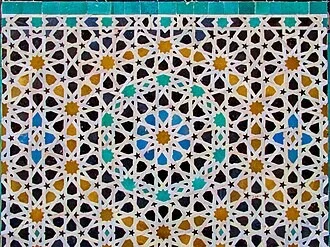
Before zellij becomes a wall, a fountain or a palace floor, it begins as clay in the hands of a Moroccan artisan. By the time it reaches the eye, much of that labour is easy to miss.
From a distance, a zellij wall can look almost effortless. A star opens into a cross; a cross locks into another star; colour seems to travel across the surface without a beginning or end. Up close, the illusion breaks into hundreds of small ceramic fragments, each cut, turned, positioned and held in place by hand.
Zellij, also spelled zillij or zellige, is a mosaic built from small, hand-cut pieces of glazed ceramic rather than from repeated whole tiles. Morocco's Hassan II Mosque Foundation sets out the sequence: clay is mixed and shaped into tiles, fired and glazed, then marked with templates and cut with a sharpened hammer into small pieces known as forma. The pieces are laid face-down on a smooth surface following a full-scale pattern. Mortar is applied to the back, and only when the panel is lifted does the finished geometry appear.
That reversal is central to the craft. The artist works from the back of the pattern, laying small tiles glazed-side down and trusting that the design will appear when the panel is turned over. In Fez, as the American travel writer Louis Werner reported in 2001, the layout artist Muhammad Rashidi spent three days placing nearly 5,000 pieces this way for a single fountain. From the back, the pieces looked like a shapeless, bumpy surface, yet he was sure the colours and design were exact. Asked why he doesn't fix the pieces to the wall one by one, he said a pattern this perfect can't be built piece by piece. A study of 14th-century examples at Chellah, an ancient necropolis in the capital Rabat, describes zellij as a technique of glazed ceramic elements cut and assembled into geometric designs. The pattern is not printed onto a tile; it is constructed from cut edges. That is why a zellij surface holds the eye: its precision comes from labour, not from a factory repeat.
Zellij is closely associated with Morocco, especially Fez and Tetouan, but it is not an isolated national ornament. The same archaeological research traces comparable cut-tile techniques across the western Mediterranean in the Middle Ages: Morocco, Muslim-ruled Iberia, Algeria and Tunisia. The story is less one of exclusive ownership than of regional exchange and parallel development. Moroccan workshops gave the practice distinct forms, colours and systems of composition, but the geometry reflects centuries of contact.
Differences within Morocco matter just as much. A 2025 announcement from the Ministry of Youth, Culture and Communication described Tetouan's zellij as shaped by a Moroccan–Arab–Andalusian tradition, with forms, colours and compositions that differ from those of other cities. Fez is often treated as the emblematic home of the craft, yet Tetouan's workshops belong to a distinct urban history shaped by its northern location and Andalusian ties. "Moroccan zellij" therefore is a useful introduction, not the end of the explanation.
The politics of heritage make those distinctions more visible. In November 2025, Morocco's culture ministry launched a national project to prepare a UNESCO nomination for the art of zellij in Fez and Tetouan. Nothing is final yet, and Algeria has filed its own zellij nomination, to which Morocco has formally objected — arguably yet another marker in the rivalry of north-west Africa's heavyweights. The dispute shows what is at stake: not merely beautiful walls, but the transmission of knowledge from a maâlem (a master craftsperson) to an apprentice, the legal protection of know-how and the question of who benefits and receives recognition as a legitimate proprietor when a traditional pattern becomes an international design fad.
That last question is already being tested. Ann Shafer's peer-reviewed study of the Fez tradition examines how local expertise meets international investment and the global presentation of zellij as Islamic heritage. The pressure cuts both ways. Attention can bring commissions and audiences, but it can also turn the pattern into a symbol of contention. In 2022, Adidas put zellij-inspired motifs on Algeria's football jerseys; Morocco's culture ministry swiftly accused the company of cultural appropriation. Adidas replied that it did not intend harm and respected Morocco's artisans. The row was about to whom belongs the design, and the people who cut it barely figured.
Craft is not a museum category, though. UNESCO's Creative Cities profile lists nearly 6,000 craft units in the northern Moroccan city of Tetouan and more than 150 young artisans entering the job market each year. Those figures cover the city's wider craft economy, including embroidery, woodwork and ironwork, not zellij alone, but they show a trade woven into daily economic life. A panel has to be ordered, cut, transported, installed and, eventually, fix.
The repairing process is where knowledge is tested. The Chellah researchers warn that historic panels can detach, glazes can deteriorate and salts can accumulate between pieces, making knowledge of earlier methods essential to restoration. UNESCO credits the use of traditional materials in Marrakesh's restoration with reviving construction-related crafts, zellij among them. Conservation, in other words, does more than preserve a finished pattern. It can sustain the people capable of making the next one.
The craft is also changing without ceasing to be itself. London’s Victory and Albert Museum profiled French-Moroccan artist Sara Ouhaddou, who works with ceramic artisans in Marrakesh on handmade tiles based on Moroccan architectural geometry. She describes the artisan as the true creator and herself as just a trigger for his imagination. Within this framework, she develops small, affordable objects with artisans that they can sell and receive the proceeds. It is one route for extending the craft without freezing it as heritage or shrinking it to a fashionable motif. The harder question is what keeps the workshops going once they get their 15 minutes of fame.
A zellij panel asks the viewer to slow down. What looks like perfect geometry is a record of clay, heat, templates, hammer blows and accumulated judgement. But a record is only readable while someone can still read it. The patterns will survive as long as there are workshops that can afford to train apprentices, restorers who know how earlier panels were made, and buyers who value the cutting as much as the colour. The pattern matters because it still has hands inside it and heart dedicated to preserving the craft. But it will only keep them if we pay for them.


Comments
JOIN THE DISCUSSION.