
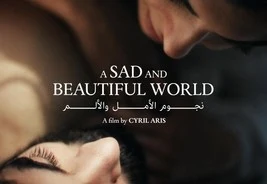
Two babies are born in Beirut a minute apart while a bloody civil war rages outside. The same day, part of the national railway is destroyed and a rocket is launched into space. “A great chapter is written in the history of Lebanon,” says the anchor. “May this day remain as a beacon of hope for our country… From Beirut to the Stars.” “But we missed the stars,” says Nino, the film’s narrator and male lead. The exchange sets the film’s tone within its first minutes, and its Arabic title, “Stars of Hope and Pain”, widens the idea: in modern Lebanon, beauty is discovered in misery, and optimism in ordinary life.
“A Sad and Beautiful World”, the first fiction feature from Cyril Aris, a 38-year-old documentary-maker, is a romantic comedy on paper, a tale of childhood sweethearts reunited after two decades. In practice the film poses a much more open-ended question. How does anyone build a relationship, let alone a family, in a country where tomorrow is a gamble? Over 110 minutes the Arabic-language film handles it with charm, but has one large blind spot.
Nino (Hasan Akil) runs his family’s restaurant. He is spontaneous and incurably optimistic, believing in love, in people and in Lebanon, never mind the facts. Yasmina (Mounia Akl), a financial advisor, is his polar opposite: watchful, deliberate and wary of promises without foundations. “I cannot bear the thought of repeating our parents’ lives,” she says. Their quarrels look at first like a clash of temperaments. They are really two ways of coping with the same harsh reality.
The film traces both positions to similar wounds. Nino’s parents were killed by a stray bullet that hit their car during the war, and he clings to the restaurant, its staff and his grandfather as relics of a vanishing world. His attachment is not only patriotic: leaving might feel like losing his home for a second time. Yasmina grew up amid a wrecked marriage and emigration, and learned to avoid commitment; she describes Nino’s way of thinking as an infectious disease. Neither is simply right. Staying in a collapsing country can be courage or selfishness; leaving can be prudence or betrayal. Aris lets neither side’s argument win.
The question dovetails with Lebanon’s reality. Since 2019, the Lebanese pound has lost more than 90% of its value, and the World Bank has ranked Lebanon’s crash among the ten worst in modern history. In the film, the economic tailspin appears in numerous motifs: an ever-changing menu price, savings trapped in a bank, a queue for passports and a whole body of policy recommendations completed for the government — only to be thrown into a drawer. The sounds of bombs in the background resonate, perhaps the 2020 Beirut port explosion, another Israeli airstrike or a political assassination.
This tragic journey is nevertheless interspersed with mundane humour. Aris’s protoganists argue over the authenticity of a classic Lebanese dish, shout at customers and laugh at impossible moments, when the audience least expects it. There is something deeply human in squabbling over ingredients while the world outside collapses. Akil and Akl hold the balance between comedy and tragedy with seamless chemistry.
The film also speaks in two visual registers, both of which map neatly onto its theme. The first is realist and recalls Aris’s documentary past: archive footage, economic decline, city streets, family arguments. This is the country the characters are obliged to live in. The second is lyrical and closer to magical realism, with soft lighting, distorted movement, dreamy sequences and electronic music. This is the country they dream of. The film moves between the two as its lovers move between caution and hope, and the lyrical register is the one that tends to win.
The main flaw lies in what the film declines to name. War, corruption and financial ruin arrive as naturally as the weather, explained as things that simply happen to the Lebanese. The 1975–1990 civil war is mentioned in passing, Israel once; Hezbollah, Iran and Syria are wholly absent. The social frame is narrow, too. Emigration to a wealthier country is not open to every Lebanese, yet the dilemma is posed only to people with some power to choose.
A defender would say that people living through disaster would logically mention it as nondescriptly as they discuss the weather, and that a love story owes no one a political analysis. Aris himself has said that earlier versions of the script were more explicitly political, but he opted to expand the romantic angle instead That is a legitimate choice. But a film about whether to stay or go is also asking who made staying put so costly, and the answer is not luck. In one scene a man is dying in an ambulance while the road is closed for a senior official. It shows that Aris can point at power when he chooses. “Capernaum”, Nadine Labaki’s angrier film, stared at Lebanon’s misery; this one is too often content to gaze at its charm.
Other issues lie in the drama. The plot leans on coincidence: the lovers are born a minute apart and meet again by chance after a car accident. The symbolism can be too neat, with the optimist and the pessimist standing as much for two attitudes to Lebanon as for two people. And a story spanning three decades takes shortcuts.

Audiences have embraced it all the same. The film won the Audience Award in Venice’s Giornate degli Autori section and the Black Iris at the Amman festival, and was Lebanon’s entry for the 98th Oscars. It is easy to see why. It is touching, sharp and often funny. It is no masterpiece, but it is a very good debut.
Near the film’s conclusion, the couple imagines an island with no shooting, no war and electricity all night. It is the Lebanon that might have been. The film is better at showing why Lebanon is loved than why it is so hard to live in. In a love story that is a forgivable failing; in a film about a country, it is a conspicuous one.
Rating: 8/10


Comments
JOIN THE DISCUSSION.