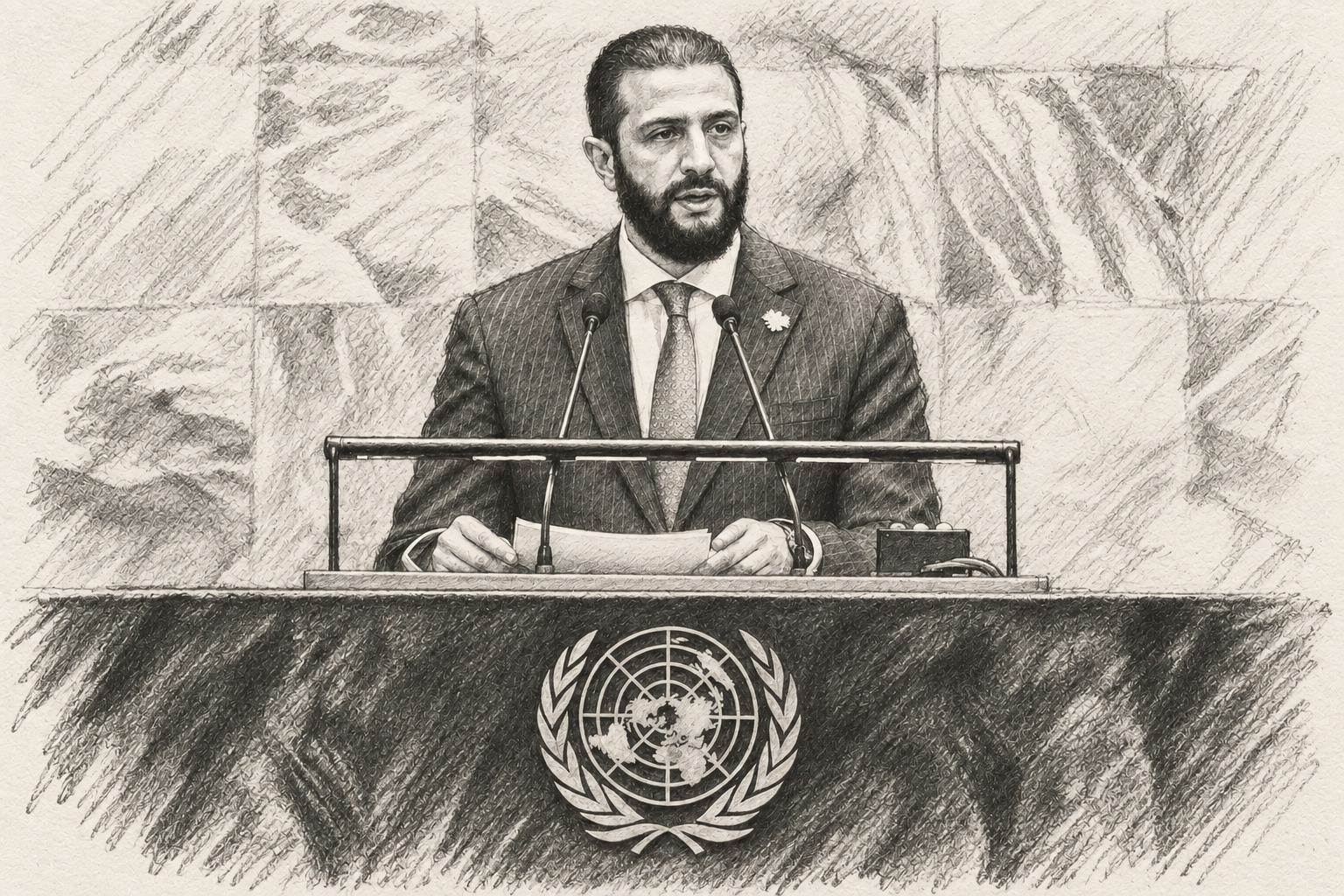
When Ahmed al-Sharaa addressed the UN General Assembly last September, he had been Syria’s president for less than a year. Foreign governments were still weighing how to deal with a former jihadist-linked commander now leading a pariah state emerging from the Assad dictatorship. His appearance in New York was itself a diplomatic achievement. Last week, he returned on different terms.
In November 2025, President Donald Trump received al-Sharaa at the White House. Chancellor Friedrich Merz welcomed him in Berlin in March; President Emmanuel Macron visited Damascus in July. America and the European Union have lifted most of their economic sanctions on Syria. Damascus has also reasserted authority over much of the country. Al-Sharaa can now approach western leaders with a government they recognise and a country they want to help rebuild.
That change has made the contrast with life inside Syria harder to ignore. Days before his UN speech, increases in fuel prices set off protests across the country. The government raised diesel prices by 40%, petrol by roughly a quarter and cooking gas by about 9%. Officials pointed to rising import prices, turmoil in energy markets and maintenance issues at the Baniyas refinery. All have pushed up costs. Diesel powers the buses, lorries and farm machinery on which Syrians depend. When its price rises, the cost of basic goods soon follows.
The demonstrations spread across six governorates, according to ACLED, a conflict-monitoring group. Idlib and Hama saw fuel protests for the first time since Assad’s fall. Some protesters blocked roads; others demanded the energy minister’s removal. Damascus then offered cheaper diesel for heating, farming and certain industries. For some Syrians, this was too little, too late.
The anger cannot be measured by these increases alone. Households have endured years of collapsing incomes and unreliable services; a sudden rise in transport costs leaves little room to adjust. The World Food Programme said in May that 7.2 million people were acutely food insecure. It had to halve its emergency food assistance because funding had fallen short. Syrians who expected sanctions relief to improve daily life have instead watched the daily cost of living go up.
Recovery was never going to be quick. The World Bank puts the cost of rebuilding damaged physical assets at $216 billion, almost ten times Syria’s projected GDP in 2024. Removing sanctions makes trade and investment possible; it does not mend a refinery or power line. Nor does it give investors confidence that contracts will be enforced and money can move safely through Syria’s banks. Macron’s visit brought business executives to Damascus. But interest will be slow to become investment while contracts are hard to enforce, banks struggle to move money and security remains uncertain.
The limits of Damascus’s authority are evident beyond the economy. In southern Syria, diplomacy has yet to bring Israeli forces back to the lines they held before Assad’s fall. At the UN, al-Sharaa also reaffirmed Syria’s claim to the Golan Heights. Israel captured the territory during the 1967 war and annexed it in 1981. Most countries do not recognise that annexation; the United States and, since August, Colombia do. Asked about the dispute in New York, al-Sharaa recalled his reply when Trump told him the Golan belonged to Israel: “Why don’t you give New Jersey to the Israelis?”
The talks with Israel concern a nearer-term issue. The 1974 disengagement agreement established a UN-monitored separation zone without settling ownership of the Golan. After Assad fell in December 2024, Israeli troops entered the buffer zone and took positions elsewhere in southern Syria. Al-Sharaa wants a return to the 1974 lines before negotiating security arrangements and, potentially, peace. He said this week that the sides had agreed on “almost 90%” of the matters under discussion before Israel pulled back or added conditions. He criticised Israel for operating in what he considers an overly aggressive post-7 October paradigm.
The state’s reach is contested at home too. Bringing the Kurdish-led north-east under Damascus’s authority has expanded al-Sharaa’s control, but Kurds will judge the agreement by what happens to language rights, local administration and former fighters. Alawites and Druze have other reasons to distrust a stronger centre. UN investigations on the Alawite-majority coast and in Druze-majority Sweida have found evidence of abuses by government forces and allied fighters, as well as by other armed groups. Sheikh Hikmat al-Hijri, an influential Druze leader in Sweida, has welcomed Israeli support and called Syrian Druze “an inseparable part of the State of Israel”. Some in Sweida share his turn towards Israel; other Druze reject his claim to speak for them. Damascus will win back trust only by protecting residents and prosecuting those responsible for abuses, including commanders where the evidence warrants it.
The Islamist origins of al-Sharaa’s movement add another test. The transitional constitutional declaration makes Islamic jurisprudence the principal source of legislation and requires a Muslim president, while also promising freedom of belief. Syrians will learn what those provisions mean from appointments, school rules and court judgments, not from reassurances in New York. Women, minorities and secular citizens need to know that they can teach, serve, worship or challenge an official without fear.
Macron’s visit showed how fragile Syria’s opening remains in the face of continuing Islamist terrorism. On 7 July, two bombs exploded near the Damascus hotel where he had spent the night, killing one person and injuring 36. Syrian authorities later said the cell responsible was linked to Islamic State. As Damascus takes over prisons and camps holding IS suspects and their families in the north-east, it must also manage a difficult security handover from Kurdish-led forces. Foreign leaders may be willing to visit Syria; preventing attacks in its capital and a resurgence elsewhere is another test of the state’s reach.
At the UNGA, al-Sharaa offered his own measure of progress. More than 3.5 million refugees and people displaced within Syria had returned, he said; schools were being rebuilt and production was recovering. He predicted that by next year Syria would begin to reap the fruits of its new partnerships. The fuel protests offered a harsher measure of how far recovery has reached.
Al-Sharaa has achieved what seemed improbable at his first UN appearance: a working relationship with governments that once shunned him. Foreign recognition has given him room to act. The question now is what he does with it.
Comments
JOIN THE DISCUSSION.