
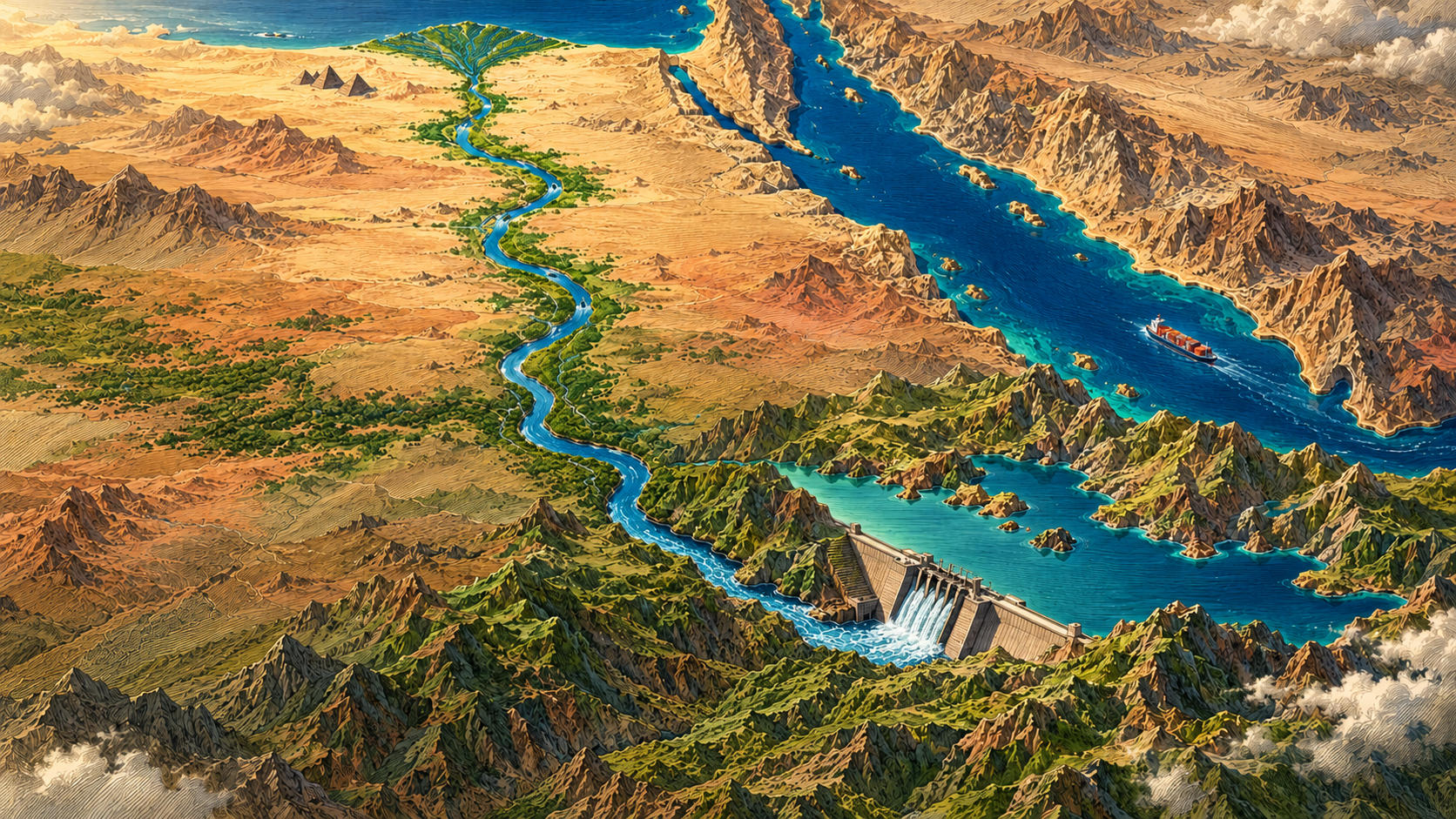
Earlier this month, Egypt hosted the leaders of Sudan, Eritrea and Somalia in the Mediterranean town of El-Alamein. Staged alongside a scheduled economic forum and periodic African Union meetings, the quadrilateral gathering was convened ad hoc to address urgent issues on which these north-east African countries are broadly aligned.
The summit's joint declaration spoke of Nile water rights, freedom of navigation in the Red Sea and the territorial integrity of Sudan and Somalia, in the language of multilateral cooperation, international law and national sovereignty. It condemned "unilateral measures" on the Nile affecting downstream Egypt and Sudan and reaffirmed the sovereignty Federal Republic of Somalia, implying the illegality of Somaliland. Yet the real protagonist went unnamed: Ethiopia. This was not lost on Addis Ababa, which quickly issued a rebuttal to the thinly-veiled claims.
Cairo gathered a coalition around the unifying idea that Ethiopia's behaviour on water, maritime access and its neighbours' internal conflicts threatens regional security. The summit highlights a growing schism between the continent's second and third most populous states, both also among Africa's ten largest economies. Their bilateral rift exposes a wider battle for influence between blocs whose memberships extend beyond the region. Some observers consider a new "Great Game" that could determine who controls natural resources, maritime chokepoints and other critical assets, with globe-spanning consequences.
The summit came days after a tit-for-tat expulsion of diplomats. Ethiopia moved first, declaring a mid-level Egyptian embassy staffer persona non grata, a step many link to the Ethiopian military chief's accusation that Egypt, Eritrea and Sudan are supporting Tigrayan rebels in the north amid an intensifying civil war. Egypt dismissed an Ethiopian diplomat in response, while Ethiopia shuttered its embassy in Eritrea and expelled 10 Eritrean officials. Asmara promptly severed relations, just as the El-Alamein gathering began.
Rhetoric during this timeframe has been equally harsh: Egypt accused Ethiopia of reckless Nile management as flooding fears rose, and Ethiopia's water minister insisted Addis Ababa will build more Nile dams without Cairo's approval, after deleting a social media post criticising Egypt's Aswan Dam that an Egyptian source denounced as shameful.
Like many historical conflicts before it, water underpins everything else. The Grand Ethiopian Renaissance Dam (GERD), under construction since 2011, was inaugurated on 9 September 2025. The dedication ceremony and its attendees would mostly foretell the geopolitical alignment surrounding the El-Alamein Declaration a year later. Tellingly absent then were the three of the four heads of the Mediterranean summit, Somalia’s President Sheikh Mohamed the exception; equally revealing was the presence of heads of states aligned with Ethiopia’s position such as Kenya's William Ruto, South Sudan’s Salva Kiir and Djibouti's Ismail Omar Guelleh — Djibouti being Ethiopia's primary conduit for seaborne access since it lost its coastline in the 1993 war that birthed Eritrean independence. For Addis Ababa, the dam symbolises sovereignty, energy security, development and pan-African pride. For Egypt, which depends on the Nile for over 95% of its freshwater, it is an existential security threat.
Having failed to prevent the dam through negotiation, and bitter at never being consulted by Addis Ababa, Egypt now faces further diversions of the Blue Nile, which originates in northern Ethiopia’s highlands and supplies 85% of the river's flow (the White Nile via Uganda provides the rest). Cairo has therefore pivoted from engagement to isolation, publicising red lines that frame unilateral Ethiopian Nile actions as a casus belli and warning of pan-African instability absent multilateral consensus. El-Alamein is the diplomatic expression of this approach: a longer-term strategy to encircle Ethiopia with allies endorsing Egypt's water claims. It may be a last resort, given Cairo's questionable ability to project hard power; it has not deployed substantial forces abroad since the 1970s and took 12 years, until 2023, to subdue a low-scale ISIS insurgency at home.
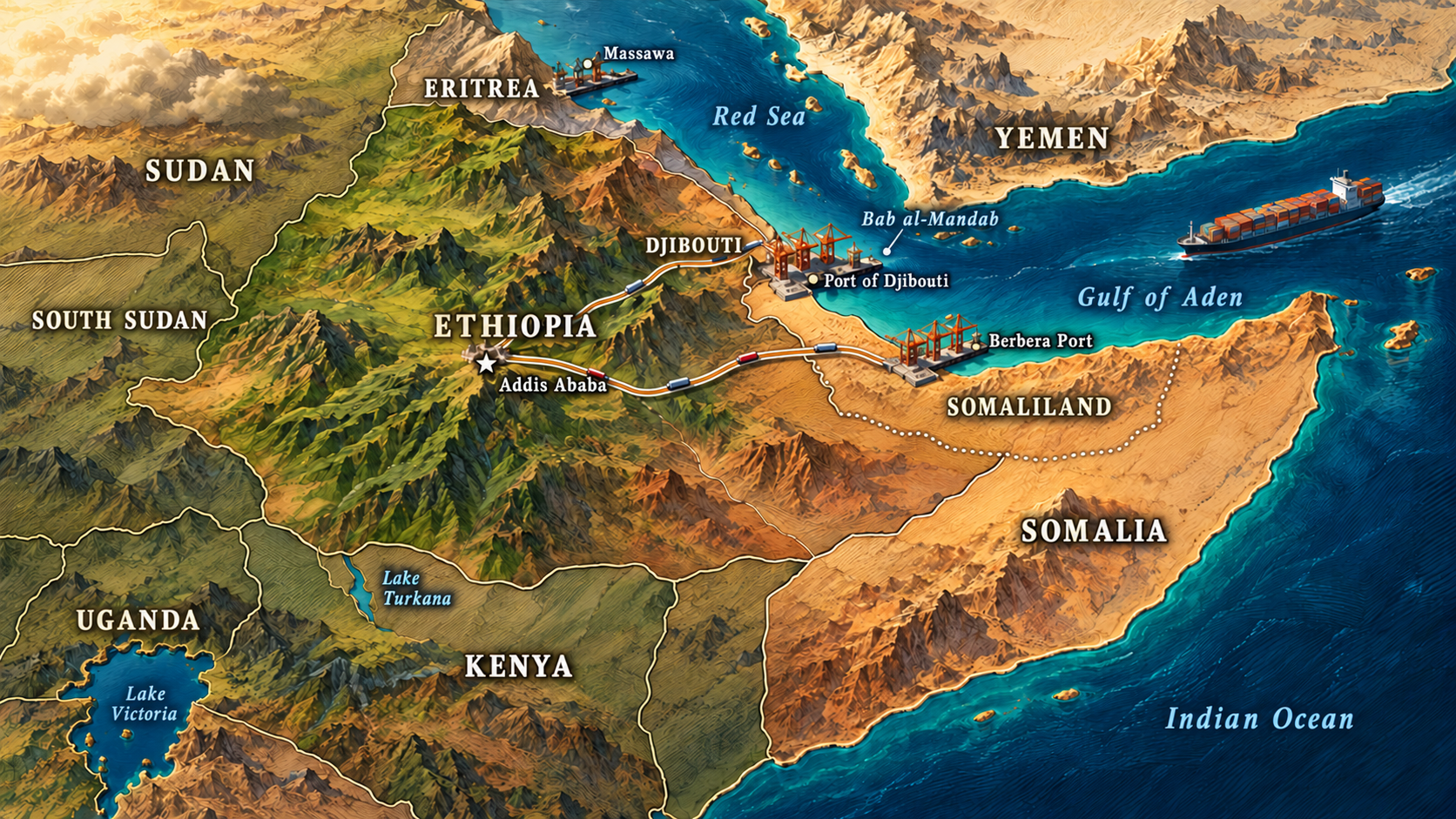
Yet the rivalry extends far beyond the Nile Basin. Ever since it lost its Red Sea coast, landlocked Ethiopia relies heavily on Djibouti. Its January 2024 memorandum of understanding to use Somaliland's Berbera port served trade diversification but challenged Somalia's territorial integrity. Mogadishu has since offered port access through its own territory, provided Addis Ababa ends the Somaliland arrangement, citing a Turkish-mediated framework from December 2024.
Ethiopia insists its maritime campaign is purely commercial; Cairo suspects cover for a permanent military presence on the Red Sea, and fears it would replicate Nile Basin leverage there. The declaration's backing for Somalia and censure of Somaliland thus serves Cairo twice over: it defends Mogadishu's sovereignty and internationalises condemnation of the Berbera route. Egypt's "freedom of navigation" language hints at fears of an Ethiopian naval deployment threatening Suez Canal revenues, which have already been sharply reduced by Houthi attacks on shipping.
The mutual expulsion of diplomats in early October highlighted a third rift between the Egyptian and Ethiopian blocs: mutual accusations of each side meddling in the internal affairs of the other. Both Sudan and Ethiopian are consumed by civil war. The Sudanese Armed Forces (SAF), recognised by most of the world, accuse Ethiopia of backing the Rapid Support Forces (RSF). Cairo is instrumental in advancing SAF leader General Abdel Fattah al-Burhan's bid for international legitimacy as the US and others try to coerce him into accepting a ceasefire. Egypt has more recently been accused of intervening militarily on the SAF's behalf, including an airstrike last week on a gold mine that killed 72 workers.
Ethiopia's own war is escalating. Fighting in the north has renewed as seven rebel groups have joined forces. Relations with Eritrea, once Addis Ababa's key partner against the TPLF, have collapsed amid Prime Minister Abiy's accusation that Asmara now supports the rebels. Drone warfare is extensive and a recent strike on a displaced persons camp has sharpened fears of spillover.
External powers complicate any perception of neatly ordered bipolarity. The Ethiopian side benefits from alliances with two influential external actors: The UAE and Israel. The UAE is widely reported to back the RSF against a broad array of regional rivals supporting the SAF, while enjoying strong ties with both Ethiopia and Somaliland. Emirati–Ethiopian relations have grown by leaps and bounds since Abiy's 2018 election, highlighted by a $3 billion stabilisation package for the Ethiopian economy and widespread infrastructure and military investment. In 2016, Abu Dhabi's DP World secured a 30-year, $440 million concession to operate Berbera port. Somalia suspended relations with the UAE in January 2026 over its alleged encouragement of Somaliland separatism, cancelling port management and security agreements.
Israel recognised Somaliland in December 2025, the only country to do so, and RSF commanders have reportedly visited Israel during the Sudanese civil war. Israel's president conducted a state visit to Ethiopia just two days before the US and Israel launched the 28 February war with Iran, symbolising a deepening alliance. A call this week between Abiy and Prime Minister Benjamin Netanyahu, which officials in both countries said merely discussed "regional developments", was therefore widely read much more than that: optics reiterating Israeli backing for Ethiopia against the Egyptian bloc. Some link growing Israeli interest in the region to countering the pro-Iran Houthis, if not Iran itself.
Egypt's position is further undermined by the fact that it is reliant on Ethiopia’s two principal allies: the UAE, whose financial generosity helps keep Egypt's economy afloat, and Israel, on which Cairo depends for a sizeable portion of its natural gas. These relationships may explain why Egypt's fiercest language is reserved for Ethiopia rather than Ethiopia's backers. Its Sunni allies are likewise cautious. Turkey, with a deep presence in Somalia, and Saudi Arabia nominally back the SAF against the RSF, yet neither has explicitly sided with Cairo against Addis Ababa. The Saudis are preoccupied with Houthi attacks on their homefront, the Turks with Gaza and Syria, seeking to confront Israeli actions closer to their doorstep; both remain wary of a still-potent Iran and have no stomach for inter-African squabbles that do not serve their immediate interests.
The El-Alamein Declaration should be read as a signal rather than a turning point. It marks Egypt's attempt to convert unsuccessful water negotiations into a regional containment strategy, piggybacking on partners' grievances against Ethiopia and its allies: Somalia over Somaliland's de facto independence, Eritrea over rising tensions with its southern neighbour, and the SAF in its quest to defeat the Ethiopian. But Eritrea is an authoritarian economic basket case, Somalia is chronically unstable, and the SAF is mired in a years-long stalemate with the RSF in a divided Sudan. Egypt's financial and energy dependence on Ethiopia's friends limits its room for action. Ethiopia faces war at home and potentially on its northern flank, calling into question its longer-term Nile and Red Sea ambitions.
For now, Ethiopia's and Sudan's internal fragmentation, Eritrean–Ethiopian border friction, the Somalia–Somaliland dispute and the Nile quarrel merge are all separate issues. But there is a risk of these files’ convergence into a single battle between the two blocs. An incident in any of these threatres leading to a high death toll, violated territorial sovereignty or wounded national pride could unexpectedly light the powder keg.
President Trump proposed to mediate in January, and the Italians in September, while the African Union urged restraint days before the declaration. Trump criticised Ethiopia’s already-completed dam on 11 October but offered no prospect of renewed US support to bridge the sides’ differences, nor has any other outside actor. Meanwhile, observers fear the threat of war in north-east Africa grows by the day. The challenge for all players, within the competing blocs and outside them, is to prevent the currently heated war of words from turning kinetic.


Comments
JOIN THE DISCUSSION.