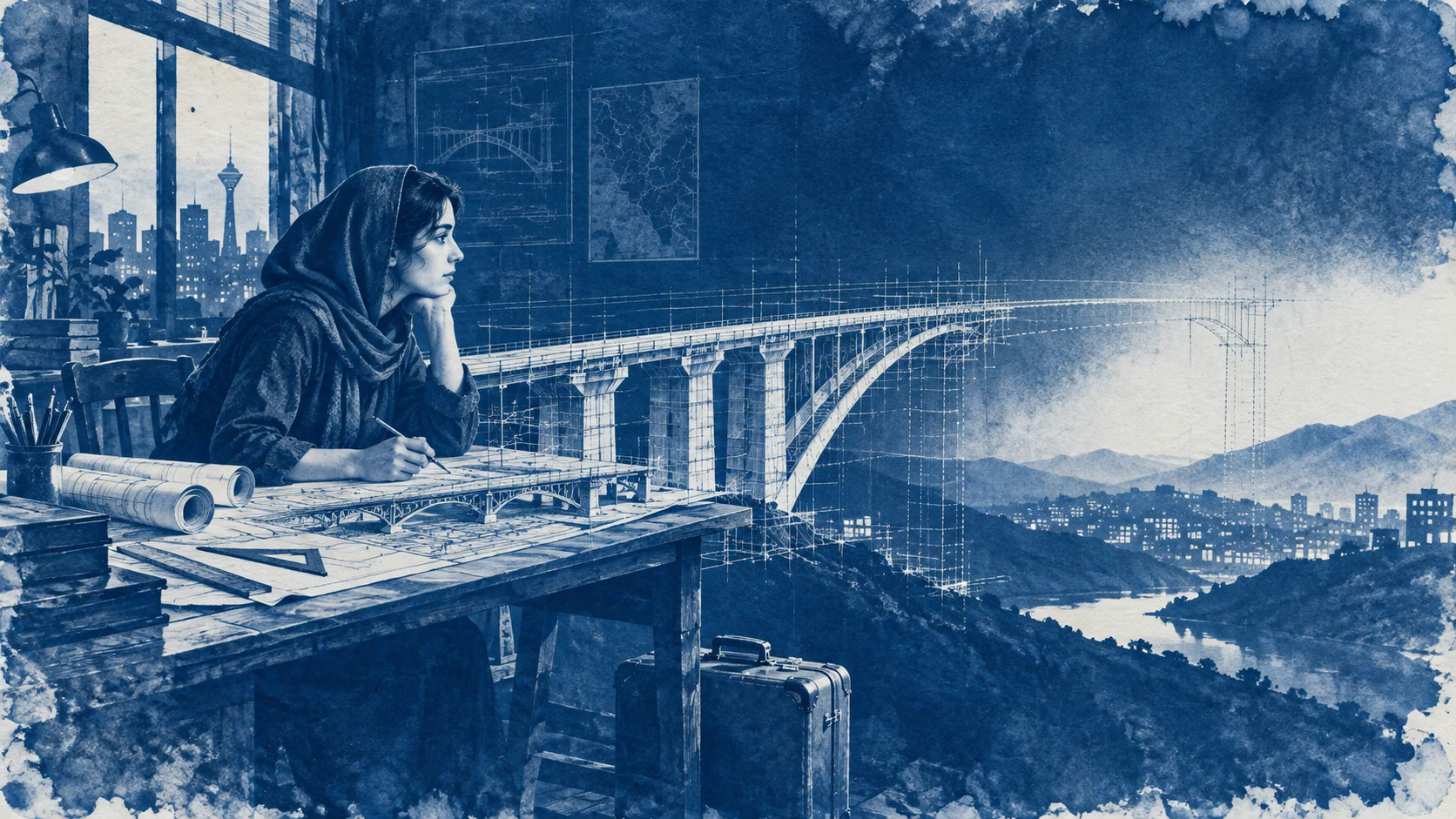
In July, more than 15,000 teenagers converged on a Tehran shopping centre because Nima Tekido, a YouTube personality, asked them to. An analyst who studied the episode read it as evidence of “a profound gap between Iran’s political elites and its youth”. For nearly five decades, the Islamic Republic has been tirelessly building institutions to shape its youth. However, their attention, the scarcest currency of the age, now belongs to creators the state neither controls nor understands.
Iran’s Gen Z, known in Persian as Nasl-e Zed, consisting of those born roughly between 1997 and 2012, makes up about a fifth of the population. Like young people elsewhere, this generation grew up with a smartphone in hand, a feed that shows an unfiltered world, and a feeling that the adults in charge have wasted its future.
In recent years, the younger generation has helped drive protests across the world, from Sri Lanka to Kenya, and from Nepal to Serbia. Their grievances differ, but digital life makes comparison unavoidable. An Iranian teenager in Isfahan or Tabriz can follow some of the same creators, hear the same music and watch the same arguments about work, relationships and personal freedom as someone in Istanbul or Berlin. Earlier generations glimpsed life abroad briefly and largely indirectly through radio, television, travel and relatives overseas. Today's young Iranians can connect to their foreign peers directly, and potentially round-the-clock, inevitably comparing their lives with them in real time. As Holly Dagres, a senior fellow at the Washington Institute, told the Wall Street Journal in its report on the January protests, “Iranian Gen Z wants to be part of the world”.
Global trends have not skipped over Iran. According to a 2024 survey, roughly 87 per cent of Iranians own a mobile phone, and a separate survey found that 85.7 per cent of Iranian students use Instagram. For Iranian youth, the undeniable truth is, that the gap between what is and what could be has narrowed.
This does not mean that all young Iranians Western-oriented or politically liberal. It does mean that the state has lost much of its former control over the content against which they judge their lives. The state’s response, from filtering and throttling to outright shutdowns, has been to treat the internet as hostile territory. The blackout imposed after the US and Israeli strikes of 28 February became the longest nationwide shutdown on record, according to netblock. It lasted nearly three months before being partially lifted, and cost the economy an estimated $1.8bn in its first seven weeks alone. Officials cited security reasons, but the regime had already reached for the same switch in January, when it cut the internet for 18 days during the protests. That the government was prepared to sever an entire country from the outside world, and to bear such a cost in the midst of war, shows how dangerous it considers a connected generation. A state that treats the platforms of everyday life as enemy territory has made itself a stranger to those who live by them.
Across the globe, Gen Z treats personal authenticity as a political value and has little patience for institutions that demand conformity in exchange for respectability. In Iran, where dress codes, gender segregation and moral policing regulate the most private matters, that attitude is potentially explosive.
Evidence of a major shift in Iranian religious affiliation comes from a 2020 survey by GAMAAN, a research group run by academics at Dutch universities. Its anonymous online survey of nearly 40,000 Iranians living in Iran found that 47 per cent said they had lost their religion, 52 per cent of those aged 20 to 29. One of its researchers described “a general process of secularisation” underway.
In a system that treats private conduct as a matter of public order, ordinary life becomes defiance by default, and families split along the fault line between parents who learned to survive by compromise and children who see compromise as the problem. One Iranian writer describes the resulting inversion neatly: “the state attempts to parent its youth” while actual parents buckle under burdens the government is required to shoulder.
In autumn 2022, the death of Mahsa Amini gave the tensions in Iran a common political language. Amini, a 22-year-old Kurdish Iranian woman, was detained by the morality police in Tehran and was pronounced dead merely days later. The ensuing Woman, Life, Freedom movement brought young women and men into the streets and drew support from artists, athletes and Iranians abroad. As protests spread, the authorities restricted access to Instagram and WhatsApp. Protesters nevertheless circulated images and testimonies using circumvention tools and other channels. Thus, the movement tied a private fight over dress to a public demand for dignity, and it taught a cohort of teenagers that politics lives in the streets, not in elections.
The protests also underlined the generation gap between this cohort and its predecessors, whose political memories differ sharply. Older Iranians lived through the 1979 revolution and the Iran–Iraq war, while later generations grew up in their aftermath. Older reform-minded Iranians remember the hopes surrounding Mohammad Khatami’s election in 1997; many millennials came of age amid the disappointment that followed the suppression of the Green Movement in 2009. Many in Gen Z inherited that disappointment without the faith.
One USA Today analysis described these young protesters as more radical and angrier than their reform-minded predecessors. The Reformists had tried to make progress through the reformation of the theocratic system, while risking the loss of friends and family, whereas many of the younger generation prefer a different approach. An Iranian sociologist at the University of Münster told ORF that Gen Z is bolder, better informed and more empathetic across gender lines than earlier cohorts, but lacks the professional prospects its elders once had.
What do they actually believe? It is less a programme than a temperament. Many prize creativity, freedom of speech and freedom of thought, and place their faith in argument and open discussion, rather than in slogans or strongmen, as the way to improve their situation. They tend to be realistic about what can be achieved and ethical in what they demand: dignity, fairness and the right to be heard. This is an intellectual generation in the plain sense of the word, curious, networked and well informed, and it is tired. It is tired of economic hardship that has put a stable career, a home and a family out of reach. It is tired of political oppression that leaves no lawful channel for complaint.
When the currency collapsed at the end of last year, the first protests came not from students but from conservative bazaar traders. By 29 and 30 December university students had joined, pushing an economic protest towards a challenge to clerical rule itself. By 8 January the demonstrations were, by one assessment, likely “among the largest episodes of social mobilization since the 1979 revolution”.
The generation's greatest strength is also its structural weakness. Like its peers elsewhere, Iran's Gen Z organises itself horizontally, without a clear leader, through group chats and shared hashtags. That makes it hard to decapitate and quick to mobilise. However, it also makes it hard to turn anger into governance, particularly when the opposition at home and abroad is split among monarchists, the People's Mojahedin, secular republicans and ethnic minority movements. In an early assessment published on 7 January, before the demonstrations reached their peak, the Miaan Group argued that sustained mobilisation, broader social participation and fractures within the state would be needed for the protests to develop into a nationwide rupture.
What, then, does the future hold? It would be a mistake to treat Iran’s youth as a single bloc waiting for a revolution. Many are pious and support the Islamic Republic’s longstanding system. Others are cautiously nationalist. Many are simply exhausted and want a job. Economic realities make the gap between aspiration and opportunity hard to ignore: inflation erodes savings, housing costs delay independence, and lack of job security makes plans for a career or family difficult. Some young Iranians want political change, while others want little more than a reliable income and the freedom to live privately. Those aspirations are not identical, but a government that can offer neither opportunity nor room for individual choice risks alienating both groups. A 2024 Stasis Institute poll, cited by pro-opposition Iran International, found that 82 per cent of Iranians aged 18 to 29 believed young people saw no successful future for themselves in the country.
Online surveys may disproportionately capture the digitally connected and those angered by economic hardship, political repression and restrictions on private life, while giving less voice to quieter or less politically engaged Iranians. The state, for its part, retains formidable coercive capacity, as even Iran International acknowledged while documenting continued youth engagement. For this generation, the existing arrangement offers neither prosperity nor dignity. The leadership can respond with further restrictions on personal freedoms, as it has so far, and probably buy a few more years of calm at the cost of a deeper rupture. Or it can take the less likely course: loosen its grip on private life, pursue a credible economic reset and give the young a meaningful say in shaping change.
The lesson of this generation, in Iran and everywhere else, is that legitimacy can no longer be inherited, it has to be earned, from an audience that is online, informed and unwilling to wait.

Comments
JOIN THE DISCUSSION.