
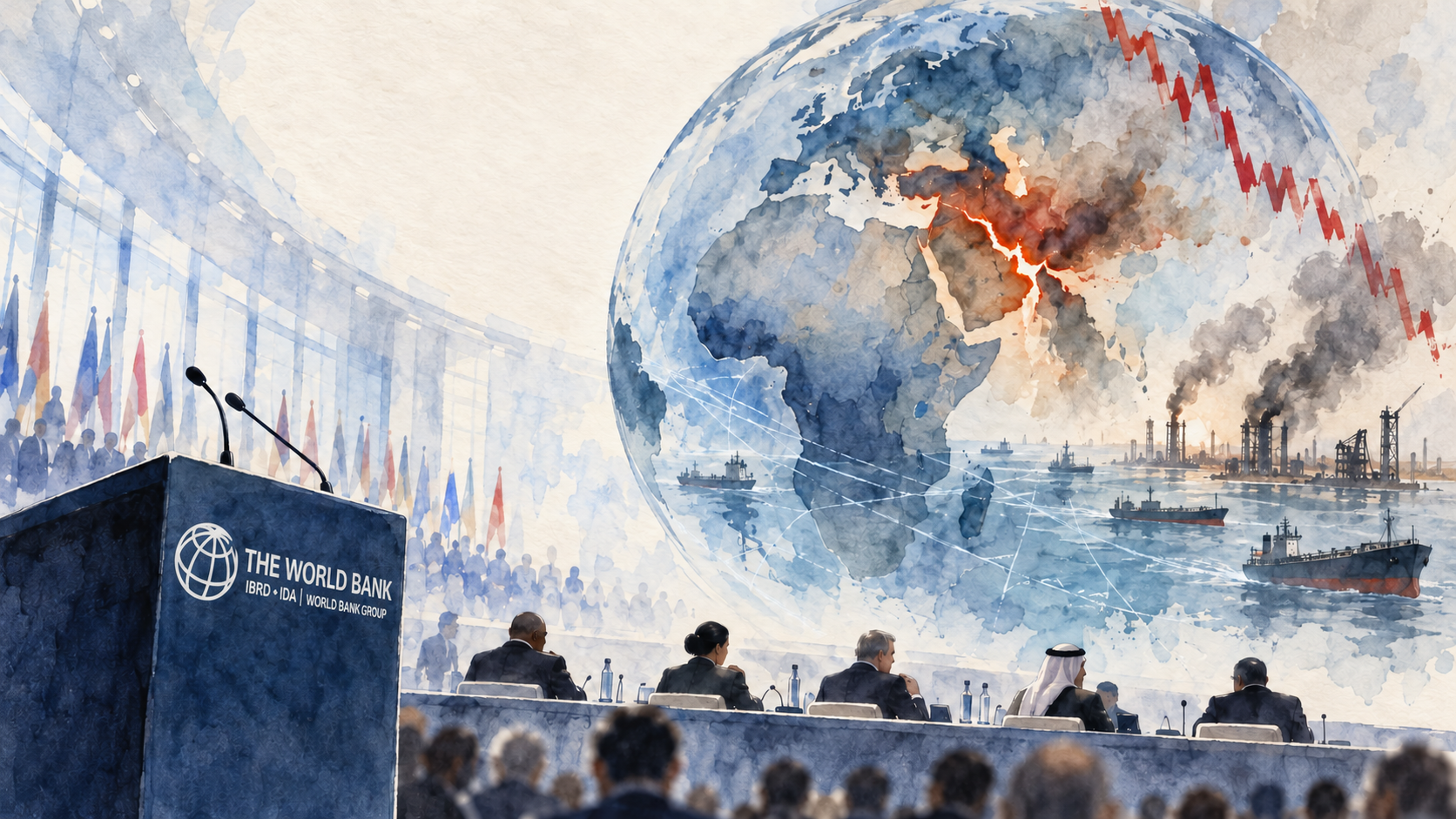
Much of the Middle East has been mired in conflict over the past three years. While the effects of war on the region are clear, its economic shockwaves were felt far beyond. The most recent, and highest-intensity conflict, broke out on 28 February 2026, with the assassination of Iranian Supreme Leader Ayatollah Ali Khamenei. The weeks-long conflict, often referred to as the US–Iran War, severely disrupted global markets. This stemmed largely from Tehran’s attempted closure of the Strait of Hormuz, a vital maritime chokepoint that normally handles roughly 20% of the world’s total oil supply. Developing countries that import energy and food are still facing the steepest economic strains from these sudden market shifts.
An interview on 11 October with World Bank President Ajay Banga, ahead of upcoming IMF and World Bank annual meetings in Bangkok, revealed efforts underway to mitigate the damage. According to Banga, the Bank is in discussions with between 30 and 40 countries on receiving emergency aid, as they grapple with high energy and feedstock costs. The Bank indicated its readiness to mobilise its rapid crisis-response facilities. Banga stated that the talks aim to help vulnerable countries navigate severe supply chain shocks and high diesel and fertiliser prices, due to the unresolved Iran conflict.
The costs of the war do not fall evenly. Economies in South and South-East Asia that rely on Gulf hydrocarbons face the most acute pressure. The heads of the IMF, World Bank and IEA stress that surging energy and fertiliser prices disproportionately hit lower-income countries. For these states, fuel is not merely a household expense. It drives electricity generation, transport and irrigation, so a price hike quickly impacts inflation, subsidies and the food supply.
Fertiliser is the less visible but potentially more damaging commodity. Higher prices before a planting season can reduce yields months later, long after the shipping lanes have reopened. This is why Banga has warned that affected countries should prepare for several months of destabilisation even after shipping routes are restored. The shock therefore arrives in two waves, first at the gas pump and then at the agricultural harvest.
So far, the global economy has shown relative resilience. This is due to strategic shifts in global oil supply and robust artificial intelligence investments, keeping immediate demands to access the fund low. Meanwhile, most affected nations are focusing on restructuring existing projects to secure short-term liquidity. However, the financial stress is growing. Developing economies owe external creditors an estimated $400 billion in 2026, with interest payments alone absorbing a third of that total. Compounded by a looming disruptive El Niño weather pattern and historically high borrowing costs, international institutions face growing pressure to fill the gap left by Western nations sharply scaling back development aid.
The numbers behind that resilience are worth examining, because they show both how much room the Bank has and how little of it has been used. When the war began, the Bank opened up $25 billion in crisis funds, yet few countries initially sought this reservoir. Banga says another $35 billion could be unlocked by diverting resources from projects already approved, bringing the first line of financial defence to $50 to $60 billion. If conditions worsen, he says the Bank could stretch to as much as $100 billion, well above the $70 billion it disbursed during COVID-19. That comparison is telling. It suggests the Bank is preparing for the possibility of a crisis larger than the pandemic, even though demand has yet to show it.
For the Middle East itself, the question is who in the region needs that money most, and how soon. The region is usually the initiator of the world’s energy shocks, but this time it is among the first recipients, because the war has turned its main export route into its main vulnerability. The Strait of Hormuz normally carries about a fifth of global oil, a quarter of liquefied natural gas and a third of fertiliser trade. Traffic through the waterway had fallen almost to a halt by early April. The IMF’s April regional outlook projected that growth across the Middle East and North Africa would slow to 1.1% in 2026, a downgrade of 2.6 percentage points from its October 2025 forecast. Growth in the six GCC countries was forecast at just 2%.
The damage is concentrated where the strait matters most. Five of the eight directly affected oil exporters, Bahrain, Iran, Iraq, Kuwait and Qatar, are projected to contract, with Qatar declining by 8.6% and Iraq by 6.8%. The Gulf is also a fertiliser source, which gives the region a second exposure. The GCC accounts for more than 40% of global sulphur exports and about 20% of ammonia and nitrogen fertiliser exports, and urea futures rose by roughly 40%. The region is therefore losing fertiliser export revenue at the same moment its neighbours are struggling to pay for fertiliser imports.
These forecasts carried an important caveat. They are a reference scenario, not a baseline, and they assume that disruption fades over the course of 2026. They were written shortly after a ceasefire announced on 7 April, and the report itself warned that a return to normal by mid-2026 was becoming less likely as the war continued. Any figure in upcoming reports, amid the continued regional tensions, should be read as a best case, not a prediction.
Regional importers look better on paper, but they are more exposed to a long war. Their growth is downgraded by only 0.3 points, against up to 15 points for the hardest-hit exporters. That said, the IMF estimates that every 10% rise in oil prices cuts their growth by about half a point, while adding about a point to inflation.
The pressure is financial. Remittances from Gulf countries account for roughly 5% of GDP in Egypt, Jordan and Lebanon. A GCC economic slowdown or fiscal adjustment could cut them. Egypt’s pound has lost between 13% to 15% of its value since mid-February, its external bond yields have risen from about 8 % to above 9%, and its interest payments are already just under 15% of GDP, with energy subsidies at about 10%. Egypt and Jordan also rely on Israeli natural gas imports respectively for 15% and 85% of their consumption, thus tying their energy security to a conflict zone. Both’s energy security to a neighbour inside the conflict zone and have witnessed their gas supply disrupted during recent Israel–Iran escalations. On 8 October, a Houthis attack on King Khalid International Airport in Riyadh killed 13, a fatal reminder that the fighting has not stayed away from Gulf territory.
The sharpest gaps are in the region’s fragile economies. In Sudan, Syria, Gaza and Yemen, food and beverages make up close to half of goods imports, and more than half the population is already food-insecure in some of them. The IMF forecasts negative growth in 2026 for Lebanon, which was recovering before a recent Israel-Hezbollah round of fighting ignited by the Iran War. These economies have the least fiscal space and are the most dependent on external aid. The IMF says official development assistance for low-income and energy-importing countries has already declined.
It is not clear how much of the World Bank’s money will reach the region, since the reporting on the talks maintains anonymity regarding the countries involved. The international body already maintains relationships with the larger importers. Egypt’s extended credit line is worth about $8.1 billion and Jordan’s about $1.2 billion, while Morocco holds a $4.8 billion flexible credit line that serves as an external buffer. The Fund says it stands ready to scale up support if risks materialise. Governments in that position have reason to prefer quieter routes, such as retooling existing projects, over a public emergency request, which matches the pattern Banga describes.
The region’s own safety net is also under pressure. The Gulf states have long acted as lender, investor and donor for less wealthy Arab countries, and the IMF notes that most GCC countries have large buffers. The question is how long they can keep spending before their own financial stability is jeopardised. The IMF estimates that the war has cut more than 10 million barrels a day of oil production and export capacity, while the post-petroleum sectors built for long-term economic diversification have been hit as well. By early April, flight departures were down about 66% in Dubai and about 75% in Doha. A Gulf under this pressure may be less able, or less willing, to support its neighbours, just as Western aid is also shrinking.
Nonetheless, the IMF still projects a rebound on the horizon, with GCC growth accelerating to 4.8% in 2027. That recovery depends on any resumed US-Iran hostilities lasting shorter than the spring conflict. If new fighting drags on, the sequence is easy to trace. Gulf contraction cuts remittances and investment, importers draw down reserves and borrow at higher cost, fragile states run short of food and fuel, and pressure on multilateral lenders grows. The risk would then move from the producers to the importers, and from a temporary shock to a lasting one. Banga’s figures show how much capacity exists to respond, while the region’s numbers show how soon it may be needed.

Comments
JOIN THE DISCUSSION.